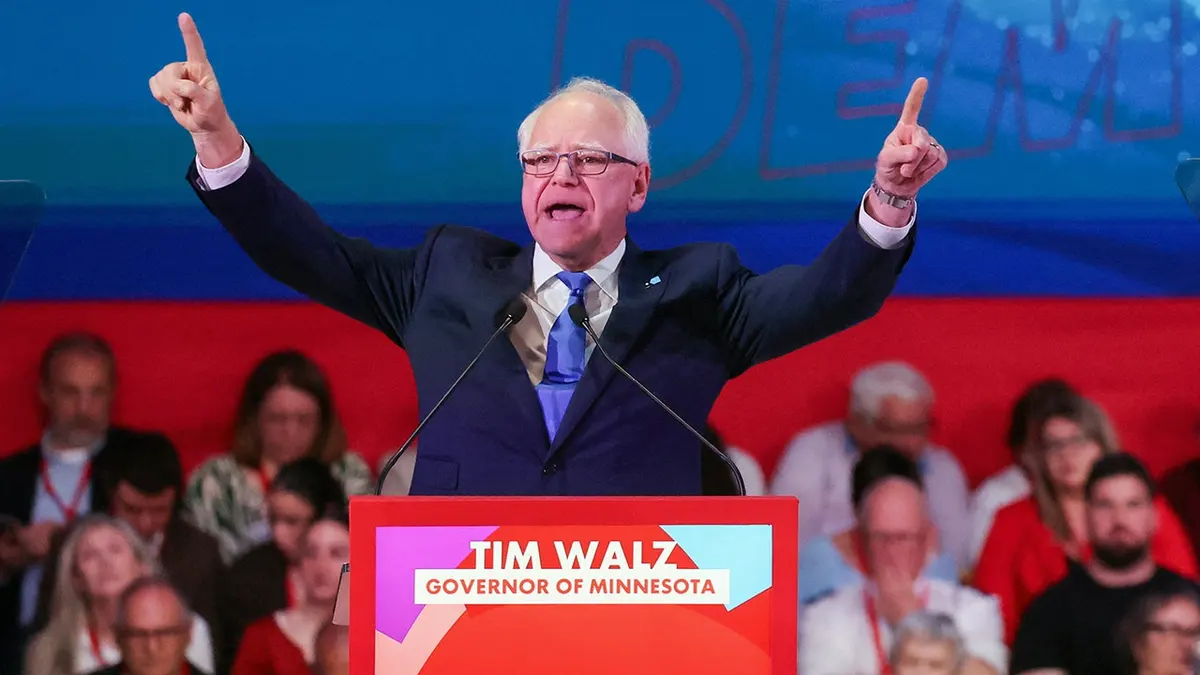

The remarks from Minnesota Governor Tim Walz add a sharp political edge to an already volatile situation involving U.S. military action against Iran. Speaking at an event in Barcelona, Walz framed the conflict in stark terms, accusing President Donald Trump of initiating a war without justification, structure, or restraint.
Walz’s language was direct and confrontational. He described Trump as “feeble-minded” and “trigger-happy,” arguing that the United States had entered a conflict where “no threat was present” and without “clear objectives” or “an exit plan.” He went further, labeling the situation as “fascism,” a characterization that underscores how deeply divided political leaders remain over both the justification and execution of the operation.
🚨 NOW: Traitor and pro-Somali Tim Walz goes BERSERK in a pathetic moment
“We've got a feeble-minded, trigger-happy president who plunged us into a war where no threat was present, with no clear objectives! That's FASCISM!”
Walz should resign NOW. pic.twitter.com/hhz4gcZ5Vr
— Eric Daugherty (@EricLDaugh) April 18, 2026
His comments stand in contrast to the rationale put forward by Trump’s administration. The strikes on Iran, carried out with Israeli coordination beginning February 28, were tied to Iran’s continued pursuit of nuclear capabilities after refusing to halt its program. That justification leans on a long-standing U.S. position that a nuclear-armed Iran represents a direct and destabilizing threat, not only to American interests but to allies in the region.
The broader context complicates Walz’s claim that “no threat was present.” Iran’s history with the United States spans decades of hostility, including support for proxy groups such as Hezbollah, Hamas, and the Houthis. These organizations have been linked to attacks on U.S. personnel and allies. Additionally, recent developments—including Iran’s reported missile launch toward Diego Garcia in March—have raised new concerns about the country’s expanding ռազմական reach and willingness to test limits.
🚨 White House says President Trump didn’t strike Iran on a whim. Secretary Leavitt says intelligence showed the regime was days from hitting U.S. targets after lying about nuclear activity and ramping up missile capability.pic.twitter.com/r3ez89zMOd
— Derrick Evans (@DerrickEvans4WV) March 10, 2026
At the same time, Walz’s criticism reflects a familiar fault line in U.S. foreign policy debates: how to define an imminent threat and what level of preemptive action is justified. His emphasis on the absence of a clear strategy or endpoint echoes past critiques of U.S. involvement in overseas conflicts, where initial military success did not always translate into long-term stability.
Trump, for his part, stated in early April that the objectives of the Iran conflict were “nearing completion,” suggesting a limited scope rather than an open-ended engagement. Whether that assessment holds depends on developments that remain fluid, including Iran’s response and the broader regional reaction.
A few thoughts on this: https://t.co/v4XxrGNQiv pic.twitter.com/xEITEpNzS1
— Guy Benson (@guypbenson) April 18, 2026
Walz’s closing line—“It’s not America First. It’s humanity first.”—signals an attempt to reframe the debate beyond national interest, though it also opens another layer of disagreement about how global responsibility should factor into U.S. decision-making.