

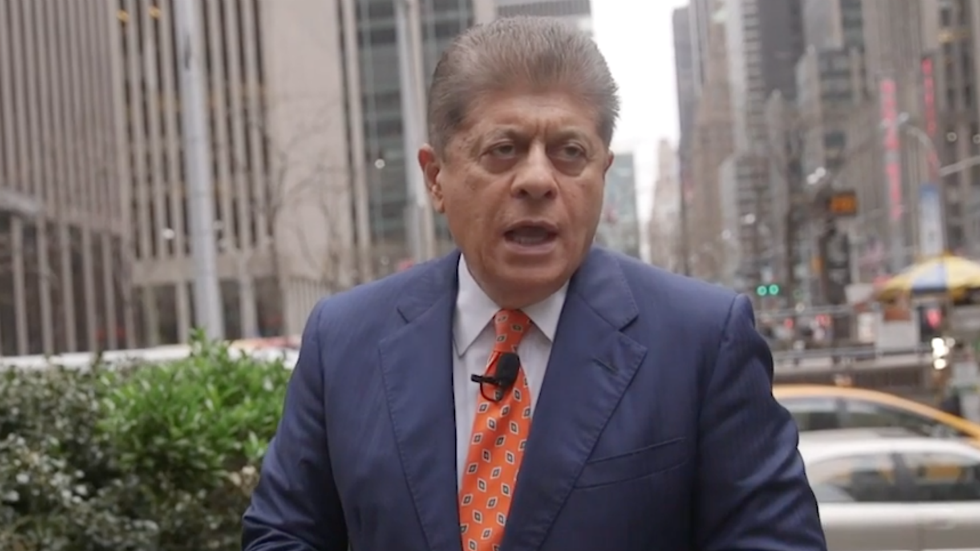

Something has shifted in the orbit of Judge Andrew Napolitano, and it’s not subtle. Once a familiar legal analyst on cable news, delivering measured constitutional takes in a polished studio environment, Napolitano now sits behind a microphone on his independently branded podcast, “Judging Freedom.” The format is looser, the guardrails thinner, and the guest list increasingly unconventional.
According to retired CIA analyst Larry Johnson: During an emergency meeting On Saturday Trump tried to “use the nuclear codes” on Iran and he was stopped by General Dan Caine.
According to Johnson “there is seriously something wrong with Trump”: pic.twitter.com/9x5LONnnsm
— Jimmy Dore (@jimmy_dore) April 20, 2026
One recent episode stands out. Napolitano hosted Larry Johnson, a retired CIA analyst who has, in recent years, become a frequent voice in alternative media circles. During their discussion, Johnson described what he claimed was a high-level emergency meeting involving President Donald Trump. According to Johnson, Trump allegedly raised the possibility of using nuclear codes in relation to Iran. The claim escalated further when Johnson added that Chairman of the Joint Chiefs of Staff, Gen. Dan Caine, intervened directly, refusing the suggestion.
The more "ex CIA" people I'm exposed to, the more I wonder about the current ones. https://t.co/CCMt4PfJkG
— Walter Kirn (@walterkirn) April 20, 2026
The weight of that allegation is obvious. It describes a moment of extreme ռազմական تصمیم-making, with global implications, and attributes decisive resistance to a top military official. Yet the conversation, at least in the available clip, moves forward without visible challenge or verification from Napolitano. His response appears truncated, leaving an open question about whether he pressed Johnson on sourcing, firsthand knowledge, or corroboration.
That’s not how they work. This is total nonsense and you are a fool for believing it and continuing to treat Larry Johnson as credible.
— Corey (@CoreysName) April 20, 2026
For longtime viewers, the contrast is hard to ignore. Napolitano’s earlier television presence was built on legal interpretation, often grounded in constitutional text and Supreme Court precedent. His role was to analyze, not amplify. The podcast environment, however, shifts that balance. Guests are given more room, and claims—especially dramatic ones—can pass through with less friction.
Yeah, let’s believe somebody from the CIA. It’s time to take these retreads off the air. Anyone who promotes them is probably suspect, hint, hint.
— Thomas Paine (@Thomas1774Paine) April 20, 2026
The comparison some are drawing is not about ideology but about format and tone. Moving from network television to independent podcasting removes layers of editorial oversight. What replaces them depends entirely on the host’s approach. In this case, critics point to moments like the Johnson interview as evidence that the line between analysis and speculation may be blurring.
What remains unclear is how intentional this shift is. Is it a deliberate embrace of more provocative voices, or simply the byproduct of a different format with fewer constraints?