


The movement of several cruise ships through the Strait of Hormuz during a period of heightened tension offers a sharp look at how commercial operators respond when official channels stall. In this case, a failed United Nations resolution and conflicting signals from Iran created a vacuum where decisions were left to ship operators and their crews.
A proposal led by Bahrain to address security concerns in the strait did not pass at the United Nations, leaving no coordinated international directive in place. That outcome drew criticism from observers who viewed it as a missed opportunity to establish clear protections for commercial traffic moving through one of the world’s most critical maritime chokepoints.
🚨 BREAKING: Keir Starmer says the UK will lead a defensive military mission with France to protect shipping in the Strait of Hormuz pic.twitter.com/QUPKaywjou
— Politics UK (@PolitlcsUK) April 17, 2026
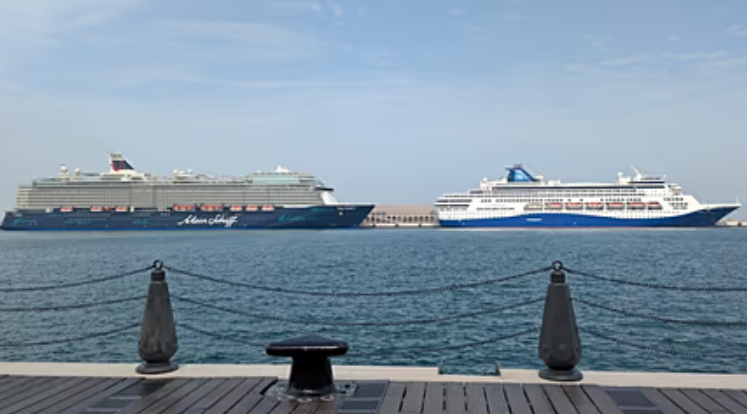
Against that backdrop, individual vessels began making calculated transits. The Celestyal Discovery had already completed a passage along the southern route near Oman. It was soon followed by four additional ships: MSC Euribia, Mein Schiff 4, Mein Schiff 5, and Celestyal Journey. These vessels had been delayed in the Persian Gulf and ultimately chose to depart, navigating close to the Omani coastline rather than relying on routes associated with Iranian oversight.
Earlier today, a convoy of 4 cruise ships ran the Strait of Hormuz at full speed, sailing under fire through the Iranian-declared minefield. pic.twitter.com/5fYSqEYcLr
— OSINTtechnical (@Osinttechnical) April 19, 2026
Tracking data indicated that at least some ships limited their Automatic Identification System (AIS) transmissions during the transit, a step sometimes taken in sensitive or high-risk environments. Reports also suggested possible hostile activity in the region, including earlier incidents involving vessels farther north, though details remained unclear.
From top right, clockwise: MSC Euribia, Mein Schiff 4, Mein Schiff 5, Celestyal Journey.
Images via @MarineTraffic pic.twitter.com/xosF25R6h7
— OSINTtechnical (@Osinttechnical) April 19, 2026
Despite those uncertainties, all four ships completed the passage. MSC Cruises confirmed that MSC Euribia safely exited the strait and is now en route to Northern Europe. TUI, operator of Mein Schiff 4 and Mein Schiff 5, stated that both ships transited successfully and credited their crews and supporting teams for managing the situation. The Celestyal Journey departed from Doha and briefly paused offshore near Khor Fakkan before continuing.
All vessels listed Muscat, Oman as a subsequent destination, reinforcing the pattern of hugging the southern corridor. That routing decision stands out, particularly given ongoing concerns about mines or other hazards in contested waters. With multiple ships now having taken a similar path without incident, attention may shift to whether that corridor is being informally treated as a safer alternative under current conditions.