

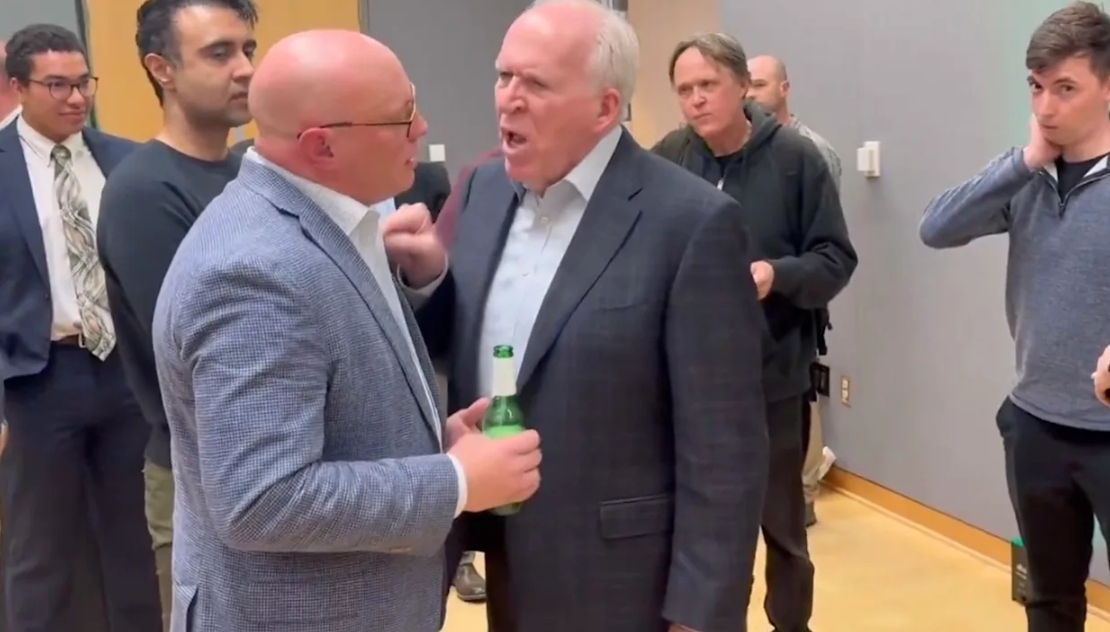

In the halls of George Mason University last Thursday, what was meant to be a high-level forum on intelligence turned into a rare and pointed confrontation — one that laid bare a growing rift between the intelligence establishment and those demanding answers for the events that helped shape a presidential election.
Former CIA Director John Brennan, once a revered figure in the national security community, found himself face-to-face with Thomas Speciale, a counterintelligence expert and former senior advisor to then-DNI Tulsi Gabbard. At the center of the exchange: a question Brennan has faced before but never adequately answered — why did he sign the now-infamous October 2020 letter, alongside 50 other intelligence officials, suggesting that Hunter Biden’s laptop bore the “classic earmarks” of a Russian information operation?
After the conference on Thursday I confronted former CIA Director Brennan directly regarding his signing the 51 Intelligence Officers Memo knowing that the Hunter Biden laptop was real and not Russian disinformation. Watch his response. pic.twitter.com/blg86oBLRb
— Thomas A. Speciale II (@Speciale4VA) November 1, 2025
Speciale’s line of questioning wasn’t merely provocative — it was surgical. He wanted to know why Brennan would attach his name to a public memo that strongly implied foreign interference, despite containing a caveat that its authors had no direct evidence of Russian involvement. Brennan’s response? “We never said it was disinformation. We said it was Russian influence operations. There’s a big difference.” But that distinction, parsed in hindsight, does little to blunt the impact the letter had at the time.
In effect, the memo created a shadow of doubt that was heavily leveraged by media outlets and Democratic operatives to cast the laptop story as suspect — conveniently shielding then-candidate Joe Biden just weeks before the 2020 election. This wasn’t a minor footnote in campaign season chaos. It was a high-profile, coordinated message from a roster of top former intelligence officials, some of whom later took roles in Biden’s administration. The stakes were not hypothetical — they were electoral.
Last night at a conference with former CIA Director Brennon I confronted him regarding the fake dossier and the Russia Collusion hoax. Listen to his response. Just FYI - I wasn't uninvited to the afterhours. pic.twitter.com/sE96meMpHA
— Thomas A. Speciale II (@Speciale4VA) October 31, 2025
Speciale didn't stop there. He also demanded an explanation for Brennan’s decision to include the discredited Steele dossier — opposition research commissioned by Democrats — in the 2017 Intelligence Community Assessment on Russian election interference. The dossier’s inclusion gave it unwarranted legitimacy, launching a media and political storm that consumed the Trump presidency for years. Brennan refused to answer. When pressed again, former CIA Director Michael Hayden interrupted with a dismissive chant: “Next, next, next.”
But the questions haven’t gone away. Nor have the consequences.
House Judiciary Chair Jim Jordan has referred Brennan to the DOJ for criminal prosecution, citing evidence that Brennan lied under oath about how the dossier came to be included in the ICA. Declassified documents show that Brennan and then-FBI Director James Comey made that call — against the objections of senior CIA officers — and pushed it forward despite concerns from other top officials, including then-NSA Director Mike Rogers.

Corrupt traitor John Brennan is still lying about the Hunter Biden laptop letter that he and 50 other “intelligence experts” put out.
Glad to see him be confronted in person on this but he still needs to be held accountable in a meaningful way for his lies. pic.twitter.com/wqxMuXFSND
— Gain of Fauci (@DschlopesIsBack) November 1, 2025
The forum may have moved on, but the country shouldn’t. A generation of intelligence leadership took part in one of the most consequential narrative shifts in modern political history — and now they appear unwilling to explain why. That silence speaks volumes.