

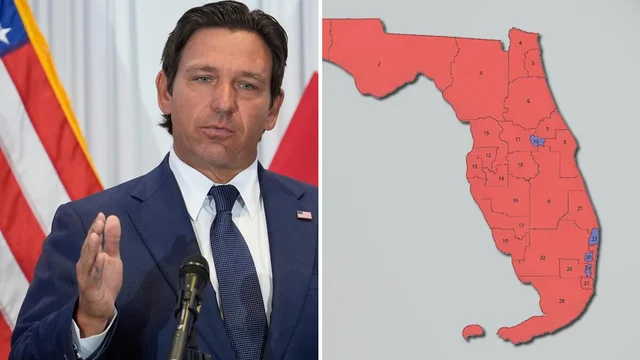

The latest round of redistricting battles has taken on a sharper edge, and the outcome in Florida is already drawing national attention. Lawmakers there moved quickly to approve a new congressional map, one that is widely expected to strengthen Republican positioning in several districts. The measure cleared both chambers of the state legislature without serious resistance and now awaits Governor Ron DeSantis’ signature, which appears all but certain.
BREAKING: The new Florida map has passed in the state senate — It now heads to DeSantis' desk to be signed into law! pic.twitter.com/amdskUmvsj
— Townhall.com (@townhallcom) April 29, 2026
DeSantis’ role in the process has been direct and unapologetic. He pushed for a map aligned with his priorities and dismissed criticism from Democratic leaders, including House Minority Leader Hakeem Jeffries, who warned of legal and political consequences. The governor’s approach reflects a broader strategy: act decisively at the state level and accept that any disputes will likely be settled in court.
BREAKING: The Florida House passed Gov. Ron DeSantis’s redistricting map in an 83–28 vote, a plan that could boost GOP House seats in 2026. It now heads to the Florida Senate. pic.twitter.com/io0XXRGnSc
— Breaking911 (@Breaking911) April 29, 2026
Florida is not the only battleground. In Virginia, a proposed congressional map that could have heavily favored Democrats has run into legal obstacles. The state Supreme Court declined to grant a stay that would have allowed certification while challenges proceed, effectively pausing momentum. That decision leaves the final outcome uncertain and underscores how quickly these efforts can be slowed once litigation begins.
🚨 BREAKING — IT'S OFFICIAL: Ron DeSantis' new Congressional map for Florida, which positions Republicans to win an extra FOUR seats in the US House, has FULLY PASSED the Senate, 21-17
It'll now head to DeSantis' desk.
GREAT JOB, FLORIDA! Other southern states MUST follow 👏 pic.twitter.com/YDnSsL9bME
— Nick Sortor (@nicksortor) April 29, 2026
Meanwhile, developments in Texas have added another layer. A recent Supreme Court decision allowed a revised map to stand, overturning lower court intervention. That ruling, combined with a narrower interpretation of Section 2 of the Voting Rights Act, has shifted the legal landscape. States across the South are now reassessing what is permissible, and both parties are preparing for further rounds of map-drawing that could reshape representation for the next decade.
🚨 JUST IN: Gov. Ron DeSantis MIC DROPS "tough guy" Hakeem Jeffries over his threats to target Florida if we redraw our map
DeSantis says MAKE MY DAY, WE'RE REDISTRICTING!
"We are not going to be COWED by threats from some MACHINE politician from Brooklyn. It doesn't work that… pic.twitter.com/BnzmvI71x8
— Eric Daugherty (@EricLDaugh) April 24, 2026
The dynamic unfolding is not subtle. Each side is working within the same legal framework but pushing it to its limits, looking for structural advantages that can endure beyond a single election cycle. What emerges is less a single contest and more a rolling series of confrontations—legislative, judicial, and political—where timing, court rulings, and control of state governments all play decisive roles.