

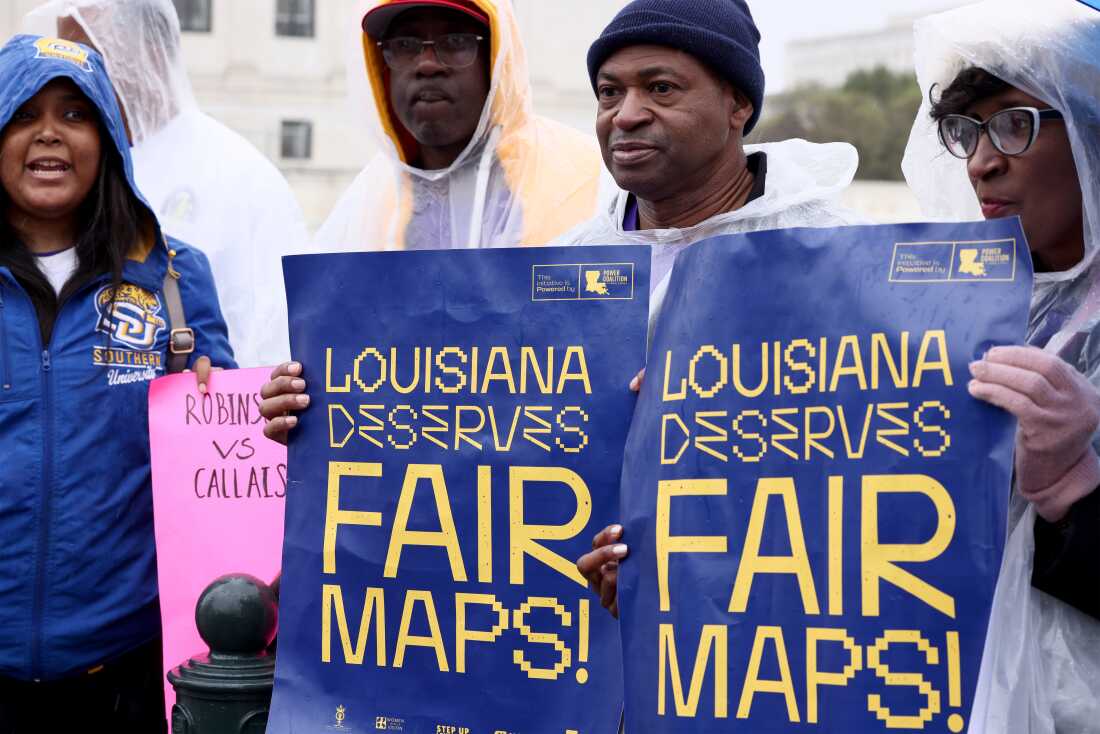

The Supreme Court’s decision in Louisiana v. Callais has set off a chain reaction that extends well beyond a single state map. What began as a dispute over Louisiana’s congressional lines is now feeding directly into ongoing fights across the South, where Section 2 of the Voting Rights Act has long been the central legal battleground.
Justice Alito has ordered a response by 4:00pm tomorrow. https://t.co/4EtsvApSpQ pic.twitter.com/srZVNefnjP
— SCOTUS Wire (@scotus_wire) April 29, 2026
Alabama stands at the front of that line. Its post-2020 congressional map was already struck down in 2023 after a 5–4 Supreme Court ruling found it in violation of Section 2, affirming a lower court’s decision. That ruling forced the creation of a second district with a substantial Black voting-age population, ultimately leading to the election of Democrat Rep. Shomari Figures in Alabama’s 2nd District. The state legislature attempted to redraw the map, but a federal panel intervened again, appointing a special master to produce a court-approved version for the 2024 cycle.
"We will act as quickly as possible to apply this ruling to Alabama's redistricting efforts and ensure that our congressional maps reflect the will of the people."
Read my full statement on the Louisiana v. Callais decision 🔗: https://t.co/0YylySio89 pic.twitter.com/LYsFe0ONbR
— Attorney General Steve Marshall (@AGSteveMarshall) April 29, 2026
Now, with Callais reshaping how Section 2 is interpreted and applied, Alabama officials are moving quickly to revisit the issue. Attorney General Steve Marshall has made clear the state intends to act on the ruling without delay, framing the decision as a rejection of race-based districting requirements. At the same time, political and legal observers are watching the Supreme Court’s next moves closely, particularly regarding pending Alabama cases that could clarify how far the new precedent reaches.
Gov. Kay Ivey declines to call special session for redistricting in light of Alabama’s appeal to SCOTUS on its map. #ALPolitics
“While we are not in position to have a special session at this time, I hope in light of this new decision, the court is favorable to Alabama.” pic.twitter.com/CL7pGQUnKE
— Alex Angle (@alexangle_) April 29, 2026
The uncertainty is not confined to Alabama. Other states with maps previously challenged under Section 2—Louisiana, Georgia, North Carolina, and South Carolina among them—are now facing similar questions. Cases that were once guided by earlier interpretations of the Voting Rights Act may be reopened, recalibrated, or fast-tracked back to the Supreme Court. In Louisiana itself, appellees have already asked the Court to move immediately to final judgment, aiming to force a redraw in time for the 2026 elections.
Alabama currently has a direct appeal pending before the Supreme Court over its court-imposed congressional map that adds a second majority-black seat.
The Court has taken no action on it since November, likely waiting for a ruling in Callais. pic.twitter.com/GvadQJvmDd
— SCOTUS Wire (@scotus_wire) April 29, 2026
At the political level, the stakes are clear. Several current congressional districts across the South were shaped directly by court rulings tied to Section 2. Any shift in that legal framework creates the possibility—though not the certainty—of new maps that could alter district boundaries and electoral outcomes. That process, however, is neither automatic nor uniform. Each state faces its own combination of legislative control, court oversight, and timing constraints, all of which will influence how and when maps are redrawn.
For incumbents like Rep. Terri Sewell in Alabama’s 7th District, the implications are immediate. Districts created or modified under prior legal standards may now be subject to renewed scrutiny, placing both existing seats and future alignments into question.