

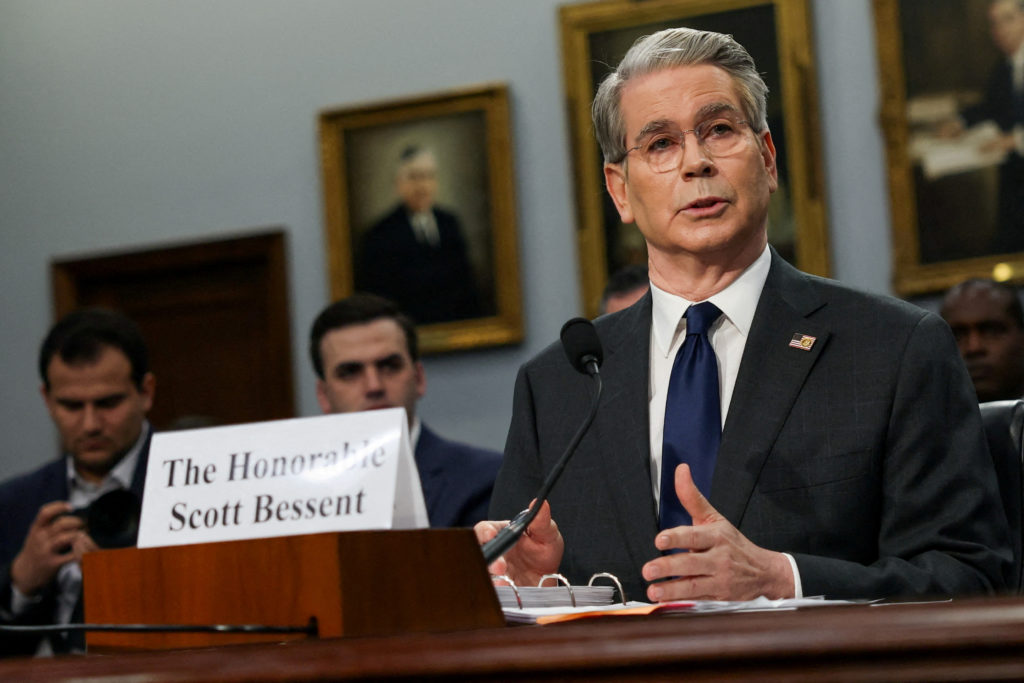

Treasury Secretary Scott Bessent returned to Capitol Hill on Thursday and once again found himself sparring with Democratic lawmakers who appeared eager to turn a budget hearing into a broader political confrontation. If Wednesday's Senate Finance Committee hearing was any indication, Democrats should have known what was coming. Instead, several members walked directly into exchanges that allowed Bessent to seize control of the conversation.
The hearing before the House Ways and Means Committee was supposed to focus on President Donald Trump's proposed 2027 budget. Yet, as often happens in Washington, some lawmakers used their time to pursue topics far removed from the Treasury Department's core responsibilities.
He's just TOO GOOD at this.
Scott Bessent enrages Rep Larson by simply directing "war" questions to the Secretary of War. pic.twitter.com/ytRDnhO5Ng
— Townhall.com (@townhallcom) June 4, 2026
One of the more striking moments came during an exchange with Rep. John Larson of Connecticut.
Larson attempted to pressure Bessent into characterizing Operation Epic Fury as a "war," a designation that carries legal and constitutional implications. Bessent refused to take the bait. Rather than stepping outside his lane, he calmly pointed Larson toward officials whose responsibilities actually include military operations and war powers.
The exchange could have ended there. Instead, Larson moved on to another line of questioning that quickly backfired.
"Are you in favor of eliminating the gas tax?" Larson asked.
Bessent began answering before being interrupted.

"Are you in favor of eliminating the gas tax? Are you able to answer that, or is that not..." Larson pressed.
"Well, if I'm not interrupted, I can," Bessent replied.
The back-and-forth continued until Bessent explained that the White House had already asked Congress to move toward eliminating the gas tax and that such a change would require legislative action.

Larson appeared caught off guard by the answer.
"You moved that? So you're in favor of eliminating the gas tax?" he asked.
Bessent repeated that the administration had requested it.
"They have?! Why isn't it before the committee for a vote?" Larson responded.
Then came the line that effectively ended the exchange.
"I don't run the agenda," Bessent said.
The moment highlighted a basic reality of how Washington works. The executive branch can propose policies, but Congress controls the legislative calendar. By asking why the proposal was not being voted on, Larson seemed to overlook the fact that lawmakers themselves would ultimately determine whether the measure advances.
🚨 OMG. Secretary Bessent just BRUTALLY EMBARRASSED this RUDE Democrat congressman
LARSON (D): Are you in favor of eliminating the gas tax?!
BESSENT: We have moved to—
LARSON: —Are you IN FAVOR of ELIMINATING the gas tax?! Answer!
BESSENT: Well if I'm NOT INTERRUPTED I CAN!… pic.twitter.com/CEqEjxcOds
— Eric Daugherty (@EricLDaugh) June 4, 2026
The exchange quickly circulated among conservatives, who viewed it as an example of a witness being questioned about a process that members of Congress themselves are supposed to understand.
Bessent's performance fit a pattern that has emerged during his recent appearances before Congress. Rather than becoming defensive when challenged, he has frequently responded with concise answers that redirect attention to the facts or to the proper chain of authority.
🚨 LMFAO!! Treasury Sec. Scott Bessent is running CIRCLES around every Democrat who tests him
REP. DELBENE (D): A DOGE staffer sent a file containing USAID info...
BESSENT: WHY are you bringing up USAID with me? Why? What does that have to do with me? USAID, I do NOT oversee. I… pic.twitter.com/K6aowaQjta
— Eric Daugherty (@EricLDaugh) June 4, 2026
That approach was also evident during another exchange involving Rep. Suzan DelBene of Washington, who questioned him about matters involving USAID. Once again, Bessent pushed back against attempts to assign responsibility for issues outside the Treasury Department's direct jurisdiction.
For the Trump administration, hearings like these provide opportunities to defend policy proposals while exposing what supporters view as weaknesses in the opposition's arguments. For Democrats, the challenge remains finding lines of attack that generate political pressure without creating moments that can be turned against them.