

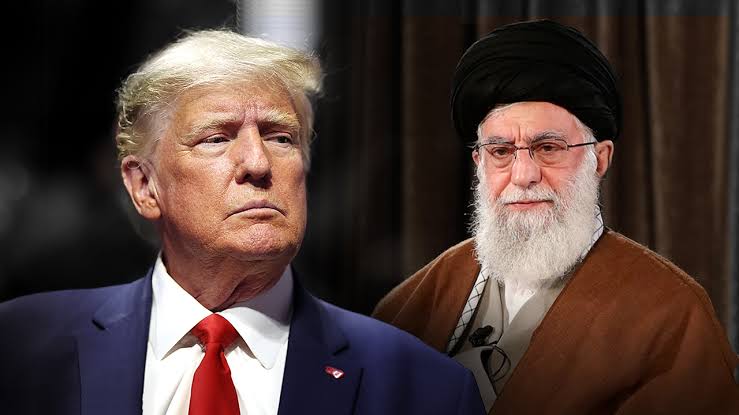

President Donald Trump said Wednesday that the United States will significantly escalate its military response against Iran following a series of attacks that rapidly intensified tensions across the Middle East.
Speaking during an interview with Fox News, Trump reacted angrily to what he described as Iran's missile attack on a U.S. military base in Jordan the previous day. According to The Times of Israel, Trump vowed a forceful response, saying the United States would "beat the f*ing st" out of Iran.
"We'll be hitting them hard. They're going to get a beating," Trump said, describing the strike in Jordan as a "surprise attack" that left American troops with only minutes to intercept incoming missiles before they reached the base.
Later on Wednesday, U.S. Central Command confirmed that American forces had launched what it described as a major military operation inside Iran.
In a statement posted online, CENTCOM announced that it had carried out "a heavy wave of strikes against Iran" in direct response to the attempted missile attacks on U.S. personnel in Jordan.
According to the military, the operation targeted dozens of facilities connected to Iran's Islamic Revolutionary Guard Corps. The strikes included military command centers, missile and drone infrastructure, coastal surveillance and defense positions, and maritime assets.
CENTCOM said the objective was to further reduce threats posed by Iran and its proxy groups against American forces, commercial shipping routes, and neighboring Gulf nations.

The confrontation continued to expand in the days that followed.
According to CBS News, Iran responded on Friday by launching drones toward Ahmad al-Jaber Air Base in Kuwait. Kuwait's Ministry of Defense said its air defenses detected hostile drones entering the country's airspace early Friday morning and successfully intercepted and destroyed them before they reached their intended targets.
Kuwaiti officials said Iran had attempted to strike multiple military and vital facilities. While debris from the intercepted drones caused material damage on the ground, authorities reported that no casualties occurred.
Iran also claimed responsibility for targeting two tankers attempting to transit the Strait of Hormuz while forcing four additional vessels to reverse course. Iranian officials asserted that the two tankers had been traveling under a U.S. air escort.
As the military exchanges unfolded, Trump gathered members of his Cabinet at Camp David on Friday, according to Reuters. The presidential retreat had already attracted attention earlier this year after a previously scheduled Cabinet meeting there in late May was canceled because of poor weather. At the time, observers viewed the planned meeting as noteworthy because of the ongoing conflict involving Iran, according to the New York Post.
Camp David has long carried historical significance in American foreign policy. CNBC noted that it was the site where President Jimmy Carter hosted Egyptian President Anwar Sadat and Israeli Prime Minister Menachem Begin during negotiations that produced the 1978 Camp David Accords, laying the foundation for peace between Egypt and Israel.
Fox Business correspondent Edward Lawrence also noted that this was only the second time Trump had visited Camp David during his second term.
Despite speculation surrounding the location, White House Press Secretary Karoline Leavitt sought to minimize its significance. Speaking last week, she described the gathering as an opportunity for Cabinet members to enjoy "a lot of fun and something different...to experience together," according to Reuters.