

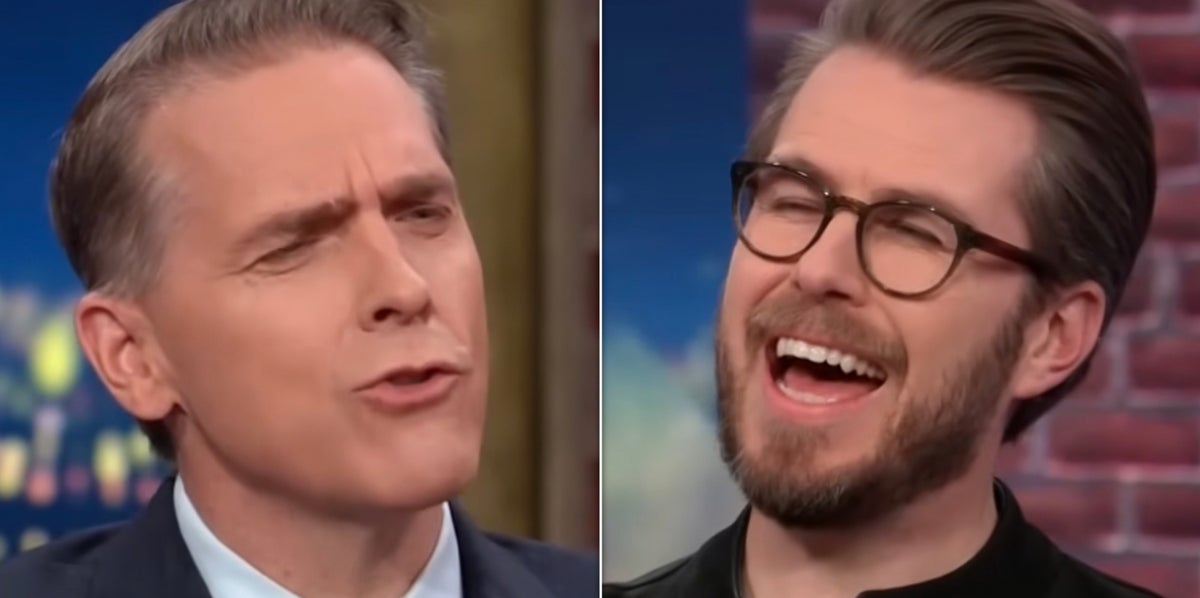

Miles Taylor’s recent CNN appearance alongside Scott Jennings drew sharp attention, but not for the reasons Taylor may have intended. The exchange quickly exposed significant gaps in Taylor’s arguments, with Jennings maintaining a more structured and fact-driven position throughout the segment. What unfolded was less a balanced debate and more a one-sided dismantling of key claims.
Miles Taylor: What Trump just did is 10 times as bad as Obama giving pallets of cash to Iran!@ScottJenningsKY: Do you think the Ayatollah prefers his life under Obama, or under Trump?
Miles Taylor: Uh, the Ayatollah is deal.@ScottJenningsKY: There you go!
Perfect 🤌 pic.twitter.com/h8cJeXotl3
— Townhall.com (@townhallcom) March 24, 2026
Taylor, often introduced in media circles as a former high-level insider, faced renewed scrutiny over the extent of his actual influence during his time in government. Critics have consistently pointed out that his role did not place him at the center of major strategic decision-making. That distinction matters, particularly when presenting oneself as an authority on sensitive national security matters. Assertions tied to operations such as “Operation Epic Fury” demand verifiable credibility, something Jennings repeatedly challenged during the discussion.
Miles Taylor is the poster boy for everything that's wrong with self-important, jackasses who get a job or two in DC and think they can run the world when they actually have no idea how to find their birth certificate and couldn't win an election without Soros cash. https://t.co/GeRkVLGX9J
— L A R R Y (@LarryOConnor) March 24, 2026
The broader issue extends beyond one television segment. Taylor’s previous anonymous op-ed, which alleged internal resistance within the Trump administration, continues to shape perceptions about his credibility. While the piece generated headlines and fueled political narratives, it also raised serious questions about internal conduct within federal agencies. His later admission of authorship cemented his role in that controversy, but it did not resolve lingering doubts about motive and accuracy.
Color me shocked that phony who leveraged a junior staffer role at DHS into a book deal as an "anonymous senior Trump administration official" is now trying to convince TV audiences he has high-level convos with foreign leaders.
Wild to even book this charlatan. https://t.co/r6gjI1v06w
— Matt Whitlock (@MattWhitlock) March 24, 2026
Ashley Williams, also present in the broader discussion cycle, encountered similar pushback. The pattern was consistent: strong claims met with firm rebuttals grounded in documented facts or logical inconsistencies. The result was a series of exchanges that underscored the importance of precision and accountability in public commentary.
GENIUS: @ScottjeningssKY set the perfect bait on CNN!
"Is there a SINGLE report today of something going awry with ICE agents...?"
MILES TAYLOR: There was an ICE agent refusing to identify himself arresting a woman...! It was in San Francisco airport!
"Do you know the… pic.twitter.com/kMFsW97ZGM
— Townhall.com (@townhallcom) March 24, 2026
Following the broadcast, Taylor escalated the situation through social media, alleging off-camera behavior by Jennings that could not be substantiated. Notably absent were direct quotes, recordings, or corroboration. In high-profile media disputes, such claims carry little weight without evidence. The lack of specificity further weakened the credibility of the accusation and shifted attention away from substantive policy discussions.