

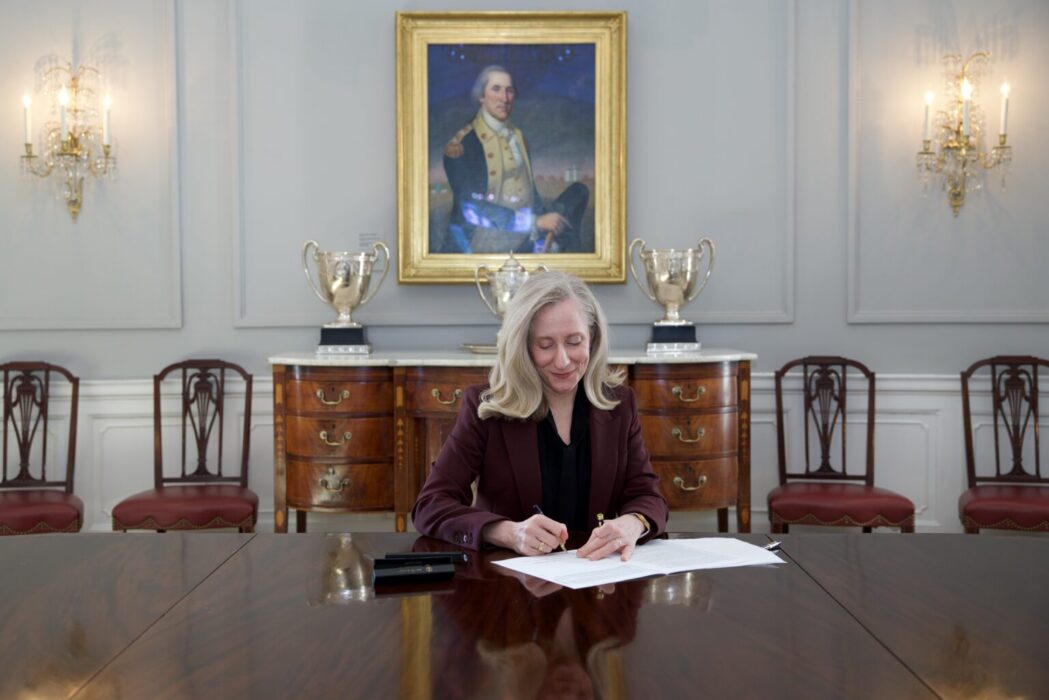

Virginia Governor Abigail Spanberger ignited an immediate legal and political firestorm Thursday after signing one of the most aggressive gun control measures in the commonwealth’s history into law — a sweeping ban targeting so-called “assault weapons,” including AR-15-style rifles.
Beginning July 1, 2026, Virginians will be prohibited from purchasing, selling, importing, manufacturing, or transferring a long list of firearms and accessories covered under Senate Bill 749. Violators face Class 1 misdemeanor charges, and anyone convicted under the law will also lose the right to purchase, possess, or transport firearms for three years following conviction.
The legislation was introduced by Democrat State Sen. Saddam Azlan Salim, a Bangladesh-born lawmaker representing deep-blue Fairfax County. After the Democrat-controlled General Assembly passed the bill, Spanberger sent it back earlier this year with proposed amendments that would have made the restrictions even tougher. Lawmakers ultimately rejected her changes before returning the legislation for her signature.
Now the lawsuits are already piling up.
VIRGINIA UPDATE: The governor has signed the "assault weapon" and magazine ban bills. https://t.co/EEYJyMzVF2 pic.twitter.com/qeongNGRzn
— Firearms Policy Coalition (@gunpolicy) May 15, 2026
The National Rifle Association filed challenges in both federal and state court almost immediately after the bill became law. The Second Amendment Foundation joined the legal offensive in state court, while Assistant Attorney General Harmeet Dhillon publicly signaled federal scrutiny by posting, “See you in court!”
Critics believe Spanberger may have handed opponents a major constitutional weapon through her own public comments.
In a statement after signing the bill, Spanberger declared:

“I am signing this bill into law because firearms designed to inflict maximum casualties do not belong on our streets. We are taking this step to protect families and support the law enforcement officers who work every day to keep our communities safe. While the General Assembly chose not to adopt my amendment that specifically carves out certain firearms frequently used for hunting, I will work with the patrons to clarify this language.”
That last sentence immediately caught attention from constitutional scholars and gun-rights advocates.
George Washington University law professor Jonathan Turley argued the governor may have unintentionally undermined her own law by acknowledging that commonly owned hunting firearms fall under the ban. Under recent Supreme Court precedent, that admission could become central evidence against the state in court.
.@GovernorVA's signing of SB749 marks a monumental victory for public safety in the Commonwealth of Virginia, banning the sale, manufacture, and transfer of assault firearms and large capacity magazines effective July 1, 2026. pic.twitter.com/XIyPAr0PJw
— Senator Saddam Azlan Salim (@SalimForVA) May 15, 2026
The legal challenge is expected to focus heavily on two major Supreme Court rulings: District of Columbia v. Heller and New York State Rifle & Pistol Association v. Bruen. Heller established that the Second Amendment protects an individual right to keep and bear arms, while Bruen imposed a far stricter historical test on firearm regulations.
Gun-rights advocates argue Virginia’s new restrictions fail both standards.
Resistance is already emerging inside Virginia itself. Smyth County Commonwealth’s Attorney Philip Blevins publicly announced he has no intention of enforcing the law, calling it “unconstitutional” and “unenforceable.” Spotsylvania County Commonwealth’s Attorney Ryan Mehaffey issued a similar statement.
Meanwhile, Salim is celebrating the bill’s passage online, calling it a “monumental victory for public safety.”
But the political stakes may extend well beyond Richmond.