

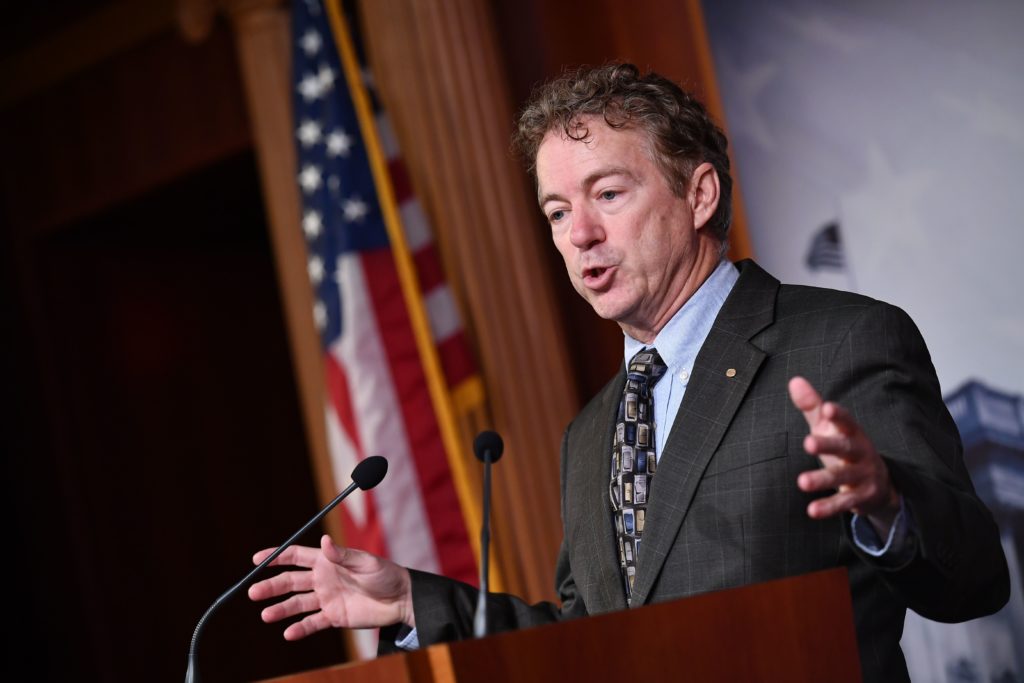

Senator Rand Paul didn’t mince words this week during his appearance on MSNBC, where he sharply criticized President Donald Trump’s newly announced TrumpRX initiative — a government-run website intended to offer discounted prescription drugs.
While the rollout of TrumpRX, complete with a deal involving Pfizer, may be pitched as a populist win for consumers, Paul raised a fundamental red flag: government ownership, even partial, of the means of production isn’t capitalism — it’s a step toward socialism.
Sitting down with MSNBC’s Stephanie Ruhle, Paul, a long-time advocate of free-market principles, drew a stark and uncomfortable comparison. “If you’re going to criticize the socialist Mamdani for wanting to own grocery stores, you better criticize Republicans who want a share of Intel, of Nvidia, or U.S. Steel,” he said, referring to New York City mayoral candidate Zohran Mamdani. “Owning even part of the means of production is a step toward socialism. It’s a bad idea and a dangerous precedent.”
Ruhle, pressing the senator on Trump’s recent comments — including the notion that the president “would love a stake in every company that’s doing well” — questioned how such a stance could be reconciled with Paul’s libertarian ethos. Paul didn’t blink.
“It’s a slippery slope,” he replied. “Heading in the direction of what socialism is.” His critique wasn’t limited to Democrats or traditional leftist policies — it was a pointed warning to Republicans who, in his view, are drifting into territory they once claimed to oppose.
When the conversation turned to TrumpRX and the partnership with Pfizer — a move that could give the federal government a branded platform to sell prescription drugs at negotiated prices — Paul’s position remained cautious but measured.
While he acknowledged that government programs like Medicare and Medicaid should leverage their size to negotiate better prices, he drew a clear line between fair negotiation and coercive involvement. “As far as bullying companies or taking a percentage of companies, I’m opposed to that,” he said. “Bullying them to offer a certain price on a new website? Doesn’t sound like something I would be for.”

Paul emphasized that taxpayer money must be spent wisely, especially in programs like Medicaid and Medicare — but added that such oversight must not open the door to government intrusion into private markets. “We should get the best deal we can get,” he said. “But not by owning the shop.”
The tension between populist economic intervention and free-market principles has always existed on the fringes of both major parties. But now, it’s inching into the mainstream — and Paul’s warning signals a growing unease among liberty-minded conservatives.