

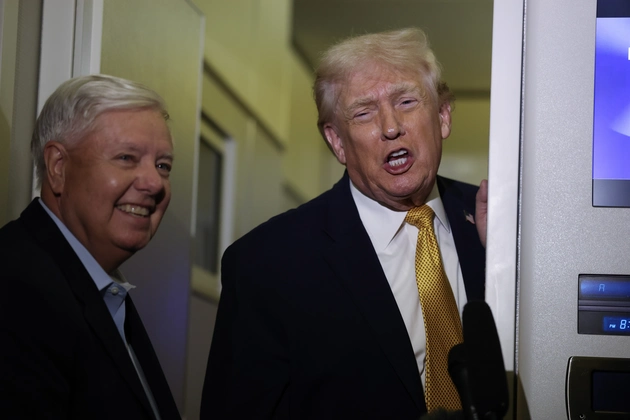

A dramatic new chapter in global geopolitics unfolded this weekend as the United States, alongside Israel, launched sweeping military strikes against Iran in what President Donald Trump described as a decisive effort to eliminate “imminent threats” posed by the Islamist regime in Tehran. The scale of the operation—described as one of the largest concentrations of American military firepower in a generation—has already sent shockwaves across the Middle East. But according to Sen. Lindsey Graham, the consequences may extend even further.
.@thejointstaff Chairman Gen. Dan Caine: “Across every domain: land, air, sea, cyber, the U.S. joint force delivered synchronized and layered effects designed to disrupt, degrade, deny, and destroy Iran’s ability to conduct and sustain combat operations.” pic.twitter.com/fITPNAWEFL
— Rapid Response 47 (@RapidResponse47) March 2, 2026
Appearing on Fox News Channel’s Sunday Night in America, the South Carolina Republican offered an unambiguous assessment of what he believes comes next. Declaring that President Trump had “finished the job that President Reagan failed to do,” Graham hailed Trump as the “gold standard” for Republican foreign policy. He pointed to what he described as the collapse of hostile regimes, referencing Venezuela’s Nicolás Maduro and asserting that “Cuba is next. They are going to fall. This communist dictatorship in Cuba, their days are numbered.”
.@SecWar: For 47 long years, the expansionist and Islamist regime in Tehran has waged a savage, one-sided war against America… we didn’t start this war, but under @POTUS, we are finishing it. pic.twitter.com/8HB9JxvFSC
— Rapid Response 47 (@RapidResponse47) March 2, 2026
The senator’s remarks came amid confirmation from President Trump that Iran’s Supreme Leader, Ayatollah Ali Khamenei, is dead. In a national address announcing the operation, Trump stated, “A short time ago, the United States Military began major combat operations in Iran.” The objective, he said, is clear: to destroy Iran’s missile stockpiles, obliterate its missile production industry, and prevent nuclear-tipped long-range weapons from ever threatening the American homeland or U.S. allies in Europe and the Middle East.
Calling Iran the “world’s No. 1 state sponsor of terror,” Trump argued that the regime has directly endangered American troops, overseas bases, and allied nations. He acknowledged the gravity of the mission, warning that casualties may occur. “The lives of courageous American heroes may be lost,” he said, adding that the campaign is being undertaken not for the present alone, but “for the future,” to ensure that a nuclear-armed Iran never materializes.
CENTCOM Update
TAMPA, Fla. – As of 7:30 am ET, March 2, four U.S. service members have been killed in action. The fourth service member, who was seriously wounded during Iran’s initial attacks, eventually succumbed to their injuries.
Major combat operations continue and our…
— U.S. Central Command (@CENTCOM) March 2, 2026
In a striking appeal, Trump addressed Iran’s armed forces and security personnel directly, offering “complete immunity” if they lay down their weapons, while warning of “certain death” if they resist. To the Iranian people, he delivered an urgent call to action: “The hour of your freedom is at hand… When we are finished, take over your government. It will be yours to take.”
Israel, facing immediate retaliation, reported multiple Iranian missile barrages overnight. Air raid sirens echoed across Israeli cities as the Israel Defense Forces moved to intercept incoming threats. Prime Minister Benjamin Netanyahu framed the joint operation as a necessary step to eliminate what he described as an “existential threat,” citing decades of hostility and violence attributed to the Iranian regime.
Three F-15E Eagles Downed in Kuwait in ‘Friendly Fire Incident’, Pilots Eject Safely Says Local Authoritieshttps://t.co/avEQgzZNks
— Breitbart London (@BreitbartLondon) March 2, 2026
Reports of explosions in Bahrain—home to the U.S. Fifth Fleet—underscored the regional volatility. Iranian retaliatory strikes have widened the theater of risk, even as U.S. and Israeli officials maintain that the objective remains focused: dismantling Iran’s capacity to wage long-range missile warfare and halting its nuclear ambitions permanently.

In another phone call this evening, President Trump told me this about the death of Ayatollah Khamenei:
"I got him before he got me. They tried twice. Well I got him first."
That’s a reference to what US intelligence believes was a plot to kill Trump in 2024.
— Jonathan Karl (@jonkarl) March 2, 2026
With the Iranian regime reportedly destabilized and its leadership structure severely disrupted, the Middle East now stands at a historic inflection point. Whether this operation will mark the definitive end of Tehran’s current ruling order remains uncertain. What is undeniable is that the strategic balance of the region has shifted—and, as Graham suggested, other entrenched regimes may be watching closely.