

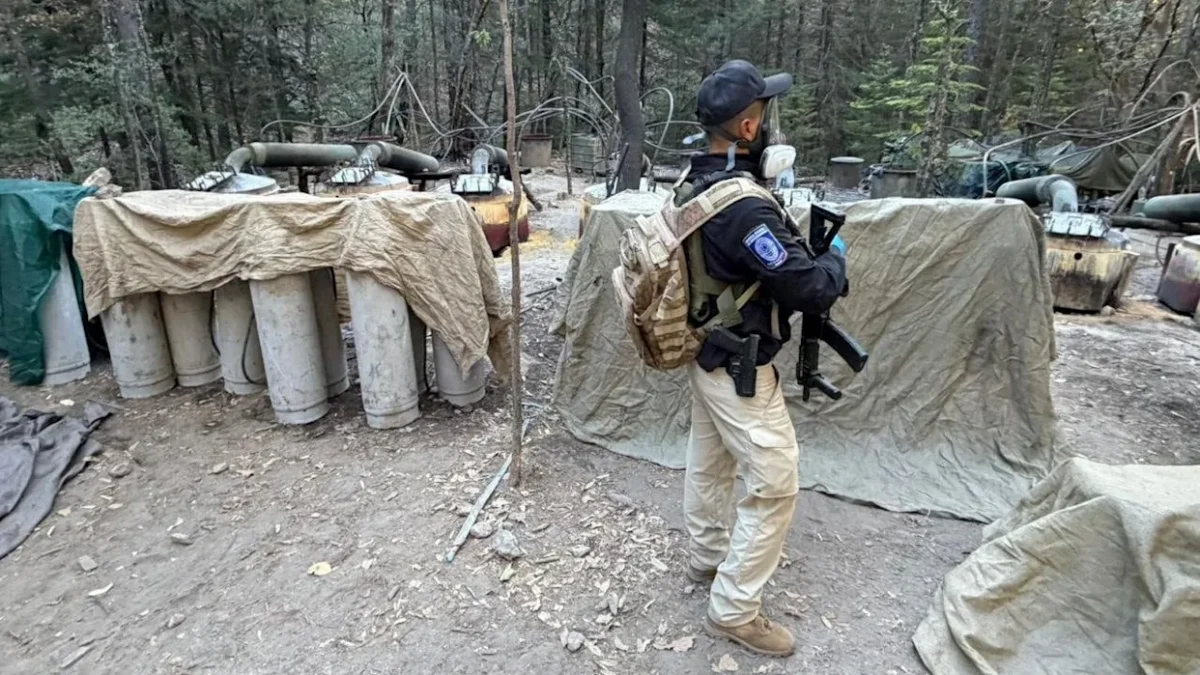

The details emerging from the mountains of Chihuahua read less like a routine report and more like a sequence of events that raises immediate, unresolved questions. Two CIA officers, working alongside Mexican personnel, were killed after their vehicle plunged roughly 600 feet into a ravine following an anti-narcotics operation.
The mission itself targeted clandestine methamphetamine laboratories—remote, difficult to access, and deeply embedded in cartel-controlled terrain. By all available accounts, the operation had just concluded when the accident occurred.
The crash has drawn attention not only because of the deaths of U.S. personnel on foreign soil, but because of what it appears to reveal about operational coordination that had not been publicly acknowledged. Mexican officials confirmed the presence of foreign personnel, while individuals familiar with the matter identified the Americans as CIA officers. The agency itself has remained silent, offering no confirmation or denial.
🇲🇽 Mexican president demands answers after car crash kills four officials, including two U.S. officials linked to embassy, revealing secret anti-narcotics operation
Mexican President Claudia Sheinbaum is soliciting answers from the U.S. Embassy and the government of Chihuahua… https://t.co/Xrr2stM3kD pic.twitter.com/1UbJkD3Qi4
— Drop Site (@DropSiteNews) April 20, 2026
President Claudia Sheinbaum’s response added another layer of tension. Standing before reporters, she made it clear her administration had no prior knowledge of U.S. personnel directly participating in operations within Mexican territory.
That distinction matters. Since 2020, Mexican law has required explicit federal authorization for any foreign agents operating inside the country. Cooperation, as defined publicly, is meant to be limited to intelligence sharing—not joint field operations. If that boundary was crossed, intentionally or otherwise, it places both governments in a politically sensitive position.
The accident has effectively forced into the open a level of collaboration that appears to have been handled quietly. Reports indicate that U.S. involvement in Mexico’s anti-cartel efforts has expanded in recent years, including intelligence sharing, training, and aerial surveillance using unarmed MQ-9 Reaper drones. These measures were framed as support roles, not direct participation. The incident in Chihuahua complicates that narrative.
Meanwhile, the broader context remains unchanged. Drug cartels continue to operate with significant control across large swaths of Mexico, particularly in regions like Chihuahua where terrain favors concealment and control. Efforts to dismantle methamphetamine production sites have intensified, but enforcement remains uneven and often dangerous.

Sheinbaum has called for answers, directing her administration to determine whether legal frameworks were violated. The U.S. Embassy has acknowledged the deaths, offering condolences, while avoiding operational details. That silence leaves a narrow space filled mostly by inference.
What happened on that mountain road was an accident. What led to those four individuals being in the same vehicle, returning from that specific operation, is where the real scrutiny now lies.