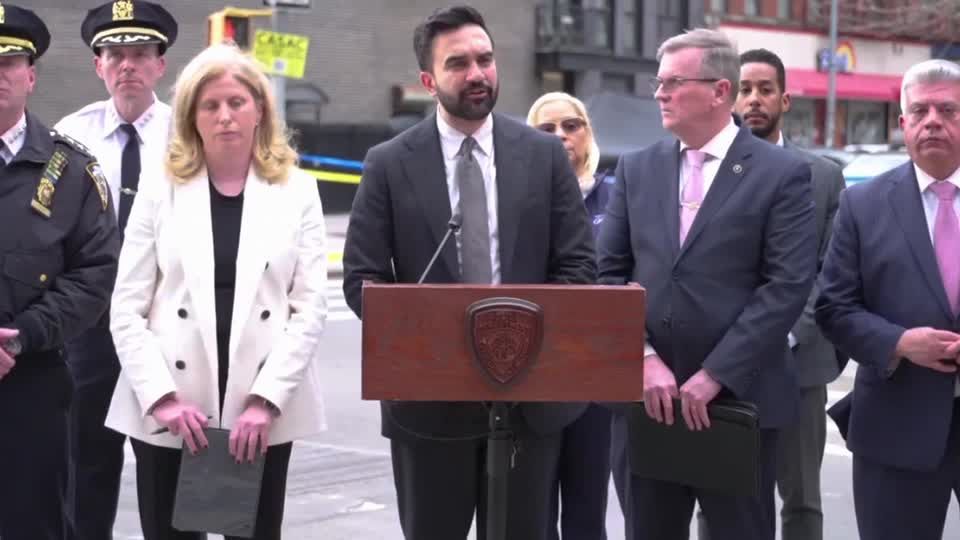

A shooting like this stops everything. It cuts through the usual noise, the press conferences, the policy fights, the daily churn of a city that rarely slows down. A 7-month-old child, Kaori Patterson-Moore, killed in a stroller by a stray bullet while walking with her parents in Brooklyn. There’s no abstraction there. No distance.
Mayor Zohran Mamdani responded quickly, calling it an “unthinkable loss” and a “heinous murder.” He thanked hospital staff and the NYPD, noting that the city cannot accept this kind of violence as normal. The words were measured, familiar in structure, the kind of statement expected in the immediate aftermath of something this severe.
A 7-month-old baby was shot and killed today in Brooklyn — an unthinkable loss.
I’m grateful for the hospital staff who did everything they could and the NYPD for their ongoing work to find those responsible for this heinous murder.
We cannot accept this violence as normal. Too…
— Mayor Zohran Kwame Mamdani (@NYCMayor) April 1, 2026
At a press conference alongside NYPD Commissioner Jessica Tisch, Mamdani described the killing as a devastating reminder of the work still needed to address gun violence. His framing placed the focus on the weapon and the broader issue of violence in the city.
Tisch, however, added a critical detail: early indications suggested the shooting was connected to gang activity, with the child as an unintended victim. That distinction matters, because it shifts the conversation from general violence to a more specific problem—targeted conflicts spilling into public spaces.
A 7-month-old baby was shot and killed today in Brooklyn — an unthinkable loss.
I’m grateful for the hospital staff who did everything they could and the NYPD for their ongoing work to find those responsible for this heinous murder.
We cannot accept this violence as normal. Too…
— Mayor Zohran Kwame Mamdani (@NYCMayor) April 1, 2026
The contrast between those two framings—one broad, one specific—sits at the center of the response.
Mamdani has a long record on policing policy. Before becoming mayor, he publicly criticized the NYPD, describing it in stark terms and supporting efforts to reduce its funding and scale. He also pushed to dismantle the department’s Criminal Group Database, a tool used to track suspected gang affiliations. Supporters of that effort argued the database cast too wide a net and risked mislabeling individuals. Law enforcement officials, including Tisch, have credited it with aiding gang investigations and preventing retaliatory violence.
Zohran Mamdani on why he wants to empty jails: "VioIence is an artificial construct" pic.twitter.com/N4G7jSmEDX
— End Wokeness (@EndWokeness) June 26, 2025
Since taking office, Mamdani has continued along that policy path. He has backed changes that limit certain enforcement strategies, supported sanctuary-focused policies, and proposed reductions in planned police hiring. At the same time, the city continues to confront incidents tied to organized crews and repeat offenders.

Public reaction to his statement was immediate and divided. Some responses focused on the loss itself, urging attention to the family and the ongoing investigation. Others pointed directly at the mayor’s past positions, questioning whether earlier efforts to scale back policing tools and personnel have left the city less equipped to prevent incidents like this one.
We don't need an investigation to know that the NYPD is racist, anti-queer & a major threat to public safety.
What we need is to #DefundTheNYPD.
But your deal with @NYCMayor uses budget tricks to keep as many cops as possible on the beat.
NO to fake cuts - defund the police. https://t.co/2RCXU8heg2
— Zohran Kwame Mamdani (@ZohranKMamdani) June 29, 2020
Those criticisms are not new, but events like this intensify them. They pull past statements and policy decisions into the present moment, where the consequences—fairly or not—are measured against a single, irreversible outcome.
For now, the investigation continues, with police working to identify those responsible. The facts of the case will develop in the days ahead. What is already clear is the sequence: a shooting tied to a larger conflict, a stray bullet, a child caught in its path.