

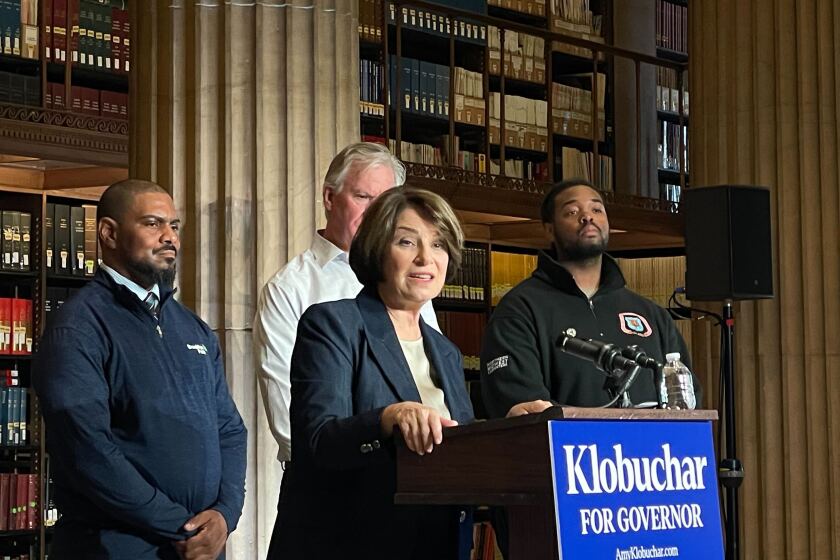

Amy Klobuchar’s pitch is straightforward on paper: launch a sweeping audit of Minnesota’s state government on day one, identify waste, fraud, and abuse, and present it as a reset on accountability. It’s the kind of line that lands easily in a campaign setting—clear, firm, and difficult to oppose in principle.
Sen. Amy Klobuchar: As Governor of Minnesota, I will go after fraud with "a top-to-bottom audit of our state government." pic.twitter.com/xZF7BbQ4uS
— Defiant L’s (@DefiantLs) May 4, 2026
But the weight of that promise depends on what follows it, and that’s where skepticism tends to settle in. Audits are not rare tools in government; they are routine, often conducted internally or by independent bodies, and they frequently produce long reports with limited visible consequences. Announcing a “top-to-bottom” review signals urgency, yet it doesn’t by itself define enforcement, penalties, or structural changes.
Wait? Is she saying Tim Walz isn’t?
— @amuse (@amuse) May 4, 2026
Klobuchar’s framing also comes with political context. She is stepping into a conversation shaped by past controversy around fraud in Minnesota programs, which has already forced scrutiny onto state oversight systems. Acknowledging that backdrop without detailing specific corrective mechanisms leaves an opening for critics to argue the proposal is more about positioning than execution.
No she won’t.
Just like the communists in MN haven’t in the past.
They will run interference because of the political donations made to the Dems by these fraudulent companies.
— John Hyde (@The_DrJ3ckyll) May 5, 2026
Her statement focuses on process—auditing, identifying, reviewing. What it does not yet outline are the downstream steps: how findings would translate into prosecutions, policy changes, or funding reforms. Those are the points that typically determine whether an anti-fraud initiative changes outcomes or simply documents problems already suspected.
I will never stop looking for my wife's killer - OJ Simpson https://t.co/Opt2yt8CIi
— Kira (@Kiradavis) May 4, 2026
There’s also a broader policy divide embedded in reactions to proposals like this. Some argue that tighter enforcement, expanded investigations, and stronger penalties are the missing pieces. Others focus on administrative fixes—better tracking systems, clearer eligibility rules, and improved inter-agency coordination. Klobuchar’s initial messaging stays at a higher level, without clearly committing to either path in detail.
Meanwhile…
Governor Tim Walz is using taxpayer dollars to sue the federal government to try and stop the Trump administration from investigating him stealing taxpayer dollars. https://t.co/f5attdRfoj
— Sue Ellen (@EstergrenSue) May 5, 2026