

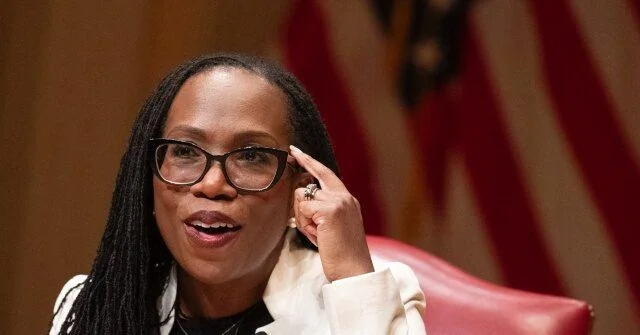

There’s a moment in every Supreme Court argument where things stop sounding like dry legal theory and start sounding like something that could actually reshape everyday life. Wednesday had one of those moments.
Justice Ketanji Brown Jackson, in the middle of oral arguments for Trump v. Barbara, leaned into a line of reasoning that immediately grabbed attention: the idea that simply being physically present in a country—even temporarily—creates a form of allegiance that could justify granting birthright citizenship.
Now, the case itself is already loaded. At the center is President Donald Trump’s executive order aimed at ending automatic citizenship for children born in the United States to illegal immigrants and foreign tourists. Critics say it’s unconstitutional. Supporters say it corrects a long-standing misinterpretation of the 14th Amendment. The Court has never squarely ruled on this exact issue, which is why this case carries so much weight.
But Jackson’s comments added a new layer to the debate.
She didn’t frame it in abstract constitutional jargon. Instead, she walked through a very concrete example: an American visiting Japan. If that American commits a crime there, Japan has full authority to arrest and prosecute them. On the flip side, that same traveler can rely on Japanese law for protection if they’re wronged. That relationship, Jackson suggested, creates what she called “local allegiance.”
And that’s where things get interesting.
Because if “local allegiance” is enough to establish a meaningful legal connection between a person and a country, then the argument follows that a child born during that temporary presence might also inherit a form of that connection—potentially qualifying them for citizenship.

That’s a significant shift from how many people understand the 14th Amendment. Traditionally, the phrase “subject to the jurisdiction thereof” has been the sticking point. Does it mean anyone physically present? Or does it require a deeper, more permanent legal attachment?
Jackson’s line of questioning suggests a broader interpretation—one that doesn’t draw a hard line between permanent residents and temporary visitors when it comes to legal obligations and protections.
Opponents of that view point to the scale of the issue. Estimates often cited put the number of children born each year in the U.S. to illegal immigrants and foreign tourists at around 250,000. Critics argue that extending automatic citizenship in these cases goes far beyond what the authors of the 14th Amendment intended, especially in a modern context where international travel is routine.

Supporters, meanwhile, argue that the Constitution doesn’t carve out exceptions based on the immigration status or intent of the parents. If a child is born on U.S. soil and is subject to U.S. law, that’s the end of the story.
What made this exchange stand out wasn’t just the legal theory—it was how plainly it was laid out. No dense citations, no tangled hypotheticals. Just a straightforward question: if the law applies to you while you’re here, does that create a meaningful form of allegiance?