

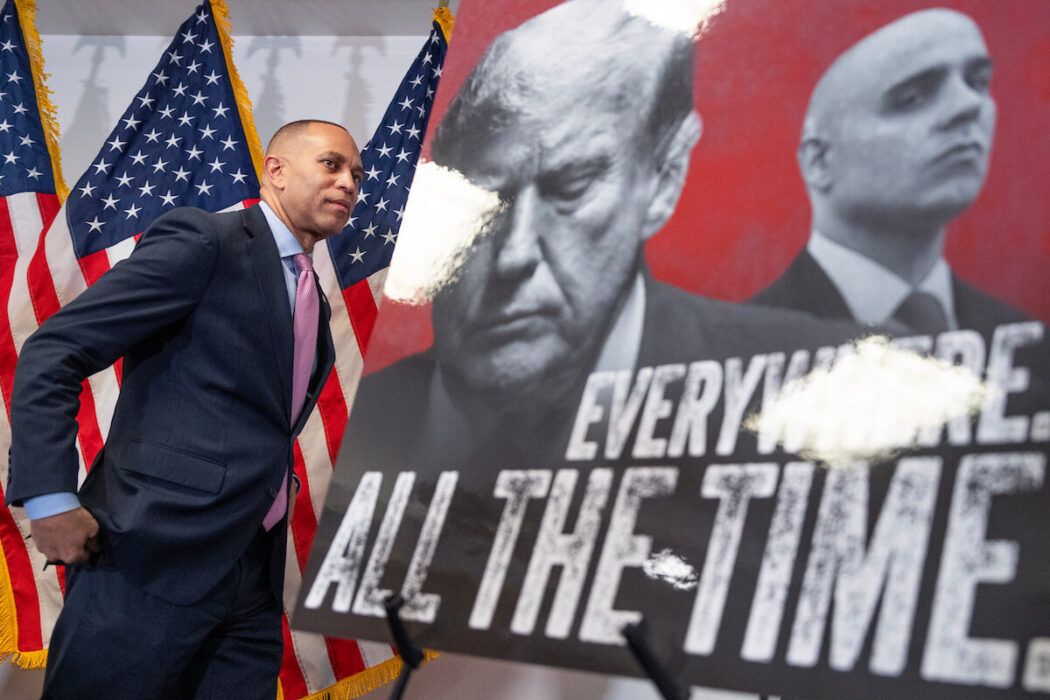

The timing alone makes it difficult to ignore. Just hours after a third assassination attempt on President Donald Trump in under two years, House Minority Leader Hakeem Jeffries stepped into the spotlight with a message that tried to walk two opposing lines at once—and ended up stumbling between them.
On Sunday night, Jeffries declared that “now is a time to unify,” but not before accusing his political opponents of being “far-right extremists” who “provide aid and comfort” to January 6 rioters. The contradiction was immediate and obvious. Calls for unity tend to lose their footing when paired with sweeping accusations aimed at the very people being asked to come together.
How does one “unify” if you are promising “maximum warfare… everywhere…all the time.” Asking for a friend. 🤔 https://t.co/aQG2HRgkJJ pic.twitter.com/RlgG0cXpwY
— Congresswoman Kat Cammack (@RepKatCammack) April 27, 2026
That tension only deepened when attention shifted to comments Jeffries had made days earlier. His call for “maximum warfare, everywhere, all the time” in the context of redistricting battles had already drawn criticism. But in the wake of a violent incident targeting a sitting president, the phrase carried a different weight. It wasn’t just partisan rhetoric anymore—it was rhetoric being re-examined under the harshest possible light.
When asked directly whether he stood by those words, Jeffries didn’t soften or reframe them. He doubled down. At a Monday press conference, he dismissed critics outright, stating, “I don’t give a damn about the criticism … get lost.” He also attempted to deflect by claiming the phrase had origins tied to a source close to Trump, a defense that raised more questions than it answered. Even if true, the relevance of that origin to his own repeated and public use of the phrase remained unclear.
What stands out is not just the language itself, but the refusal to recalibrate it given the moment. Political rhetoric often pushes boundaries, but there have been recent precedents where leaders from both parties urged restraint following acts of violence.
After the attempted assassination of Gabrielle Giffords, there was a visible shift in tone across much of the political landscape, at least temporarily. Terms and imagery perceived as aggressive were reconsidered, even avoided.
Calling for “Maximum Warfare” against Republicans two days after an assassination attempt. Democrats are insane. pic.twitter.com/4RlYFtL5pI
— Brent Scher (@BrentScher) April 28, 2026
Here, that pattern appears absent. Instead, the language has hardened, and in some cases intensified, even after multiple violent incidents tied to the same political figure. The result is a growing disconnect between calls for unity and the language used to frame political opposition.

Jeffries’ response, particularly the blunt dismissal of criticism, adds another layer to the situation. It suggests a calculation that standing firm—even in the face of heightened scrutiny—is preferable to walking anything back.