

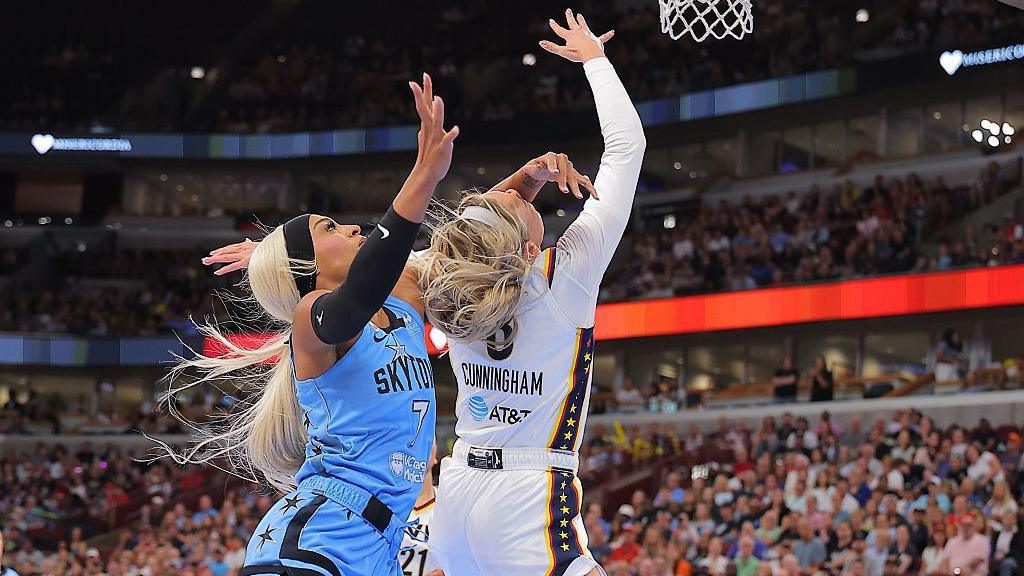

DiJonai Carrington is trying to explain what she meant by a “WHITE PRIVILEGE” social media post after her ejection from Saturday’s WNBA game, but her latest explanation has only added another layer to the controversy.
The Chicago Sky player was tossed after a hard foul on Indiana Fever guard Sophie Cunningham, catching Cunningham high as she drove toward the basket. Carrington later posted “WHITE PRIVILEGE” on social media and tagged the Fever’s account, ensuring the message was directed squarely into the conversation surrounding Indiana and the game.
That prompted former NFL linebacker Emmanuel Acho to challenge Carrington’s apparent argument on his podcast.
DiJonai Carrington gets ejected for absolutely clocking Sophie Cunningham in the face and immediately takes to Threads claiming white privilege…
Maybe worry about hacking somebody across the head?? pic.twitter.com/RhwfrzV4a9
— OutKick (@Outkick) August 8, 2026
“So to me, it was just very ignorant and, to some degree, asinine by D.J. Carrington to suggest that that call was based on white privilege,” Acho said. “Have we seen examples of white players make that same foul and get away with it? Have we seen examples of black players make that same foul and get away with it? Yes. There was no white privilege involved in that specific call.”
Carrington responded by insisting Acho had misunderstood her.
“I’ve never once claimed that the assessment of the foul was white privilege (that was your assumption),” she wrote on X, before telling Acho to exercise his “critical thinking skills.”
Carrington then defended her familiarity with the subject, pointing to her education at Stanford and saying she had studied the issue. She maintained that she would not use the term “white privilege” merely as a rhetorical weapon without evidence.

There is an obvious problem Carrington now has to overcome: if her “WHITE PRIVILEGE” post was not referring to the foul or its punishment, what exactly was she referring to?
That remains decidedly unclear.
Cunningham, meanwhile, offered a considerably more straightforward interpretation of what happened.

The price of standing for girls and women pic.twitter.com/9E5KWjuWg4
— Riley Gaines (@Riley_Gaines_) August 9, 2026
“This has nothing to do with race,” Cunningham told reporters. “Last year, I did the same thing, and I got kicked out. And I deserved to be kicked out. There’s no reason even to play that card.”
That comparison goes directly to Acho’s argument. Cunningham is white, committed a similar type of offense previously and was ejected. Carrington received an ejection after her foul Saturday. Whatever larger argument Carrington intended to make about race, she has explicitly denied that she was saying the foul assessment itself amounted to white privilege.
That leaves her original post hanging there without much explanation.
More importantly, the episode comes amid continuing scrutiny of physical play in the WNBA. Officials actually responded to Carrington’s foul with an ejection rather than allowing the incident to disappear into another round of arguments over what should or should not have been called.
I’ve never once claimed that the assessment of the foul was white privilege (that was your assumption). Try exercising your critical thinking skills, I know you studied psych. Furthermore, I’m the LAST thing from ignorant or asinine when it comes to speaking on “white privilege”,… https://t.co/mykXGTtiXJ
— dιjonaι carrιngтon♛ (@DijonaiVictoria) August 10, 2026
Players can debate officiating. They can criticize inconsistent enforcement. They can also raise questions about race when there is evidence relevant to the situation. But Carrington’s attempt to separate a pointed “WHITE PRIVILEGE” post from the very incident unfolding around her requires an explanation more specific than saying everyone else made the wrong assumption.
For now, Cunningham’s comparison remains difficult to get around: she says she previously crossed the line, got thrown out and deserved it.
This time, Carrington crossed the line and got thrown out.
The WNBA made the call. The punishment followed. And Carrington’s subsequent explanation has done little to clarify what she believes “WHITE PRIVILEGE” actually had to do with any of it.