

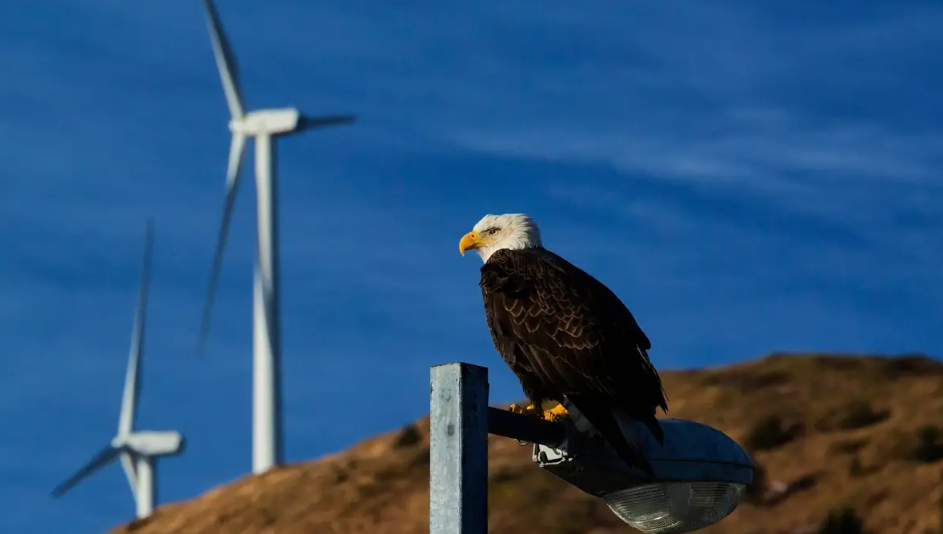

The University of Minnesota now finds itself at the center of a grim and symbolically charged controversy after federal officials proposed a civil penalty of more than $14,000 over the death of a bald eagle at one of its wind energy research facilities.
The incident did not occur at a commercial wind farm tucked away on a distant prairie, but at the university’s own Eolos Wind Energy Research Field Station in Dakota County, a site intended to advance renewable energy technology under the banner of environmental responsibility.
According to documentation reviewed by Fox News Digital, the bald eagle was struck by a university-operated wind turbine and killed in a violent manner that left little ambiguity about the cause. Photographs show the bird dismembered into three pieces, its remains scattered below the turbine.
Technicians initially discovered only the lower torso and tail, while the head and wings were not recovered until more than a month later, underscoring both the severity of the collision and the delayed realization of its full scope.
Federal officials say the university violated the Bald and Golden Eagle Protection Act by operating the turbine without an “incidental take permit,” a requirement designed to regulate activities that may unintentionally harm protected species.
The Department of the Interior has proposed a penalty of $14,536, describing the bald eagle as a “national treasure” whose loss carries legal as well as symbolic weight. Notably, the violation notice indicates the university was already aware that bird collisions posed a risk and was actively testing collision detection sensors at the time of the incident.
In the aftermath, the U.S. Fish and Wildlife Service urged the university to reassess the turbine’s danger to eagles and to apply for a long-term incidental take permit. However, the Department of the Interior’s January notice does not suggest that such a permit has since been obtained.

The turbine itself is part of the Eolos Wind Energy Research Consortium, and its construction was funded by a $7.9 million Department of Energy grant awarded in 2010 during the Obama administration, money drawn from the broader American Recovery and Reinvestment Act’s massive clean energy spending push.
This case is not isolated. Federal wildlife officials have recently pursued similar enforcement actions against renewable energy companies, including fines totaling more than $32,000 against Ørsted Onshore North America for two bald eagle deaths linked to wind turbines in Nebraska and Illinois. Interior Secretary Doug Burgum has pointed to such incidents as evidence that large-scale wind and solar projects come with hidden costs, arguing they destabilize the grid while driving up prices.