

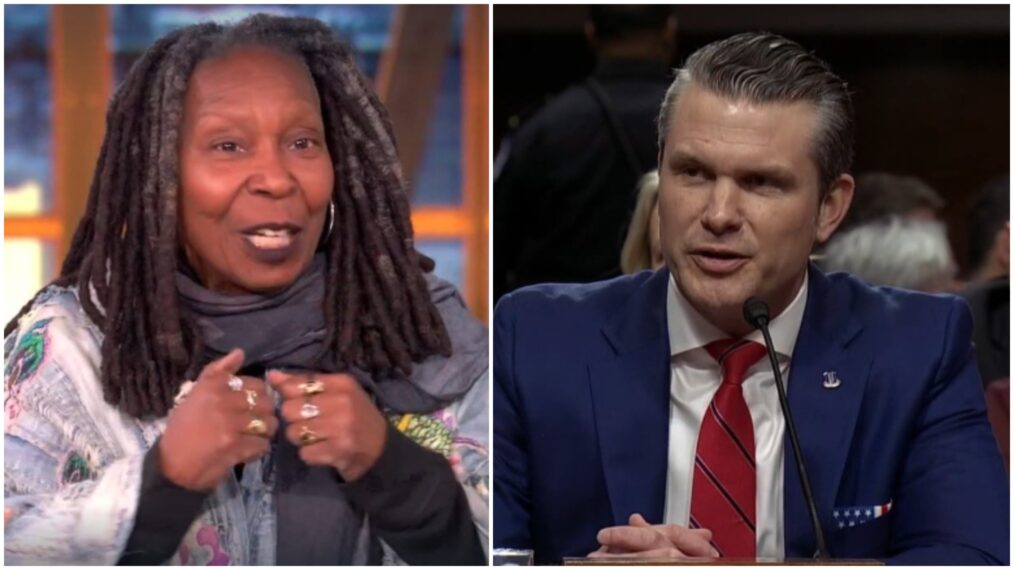

In the latest episode of The View’s foray into military ethics and battlefield law — a realm notably distant from its usual terrain of celebrity gossip and pop culture debates — Whoopi Goldberg and her cohosts took aim at War Secretary Pete Hegseth, claiming he “set up” American service members to take the fall for alleged war crimes. The charges, speculative at best and legally shaky at worst, rest on the still-developing story of the September 2 narcoterrorist boat strike — an operation ordered under the Trump administration to disrupt cartel-linked maritime drug trafficking in the Western Hemisphere.
Let’s start with what Goldberg and her co-panelists got right: U.S. service members are obligated under international law to disobey illegal orders. That’s a foundational principle of the Uniform Code of Military Justice and the Geneva Conventions. But here’s where the panel veers from serious analysis into theatrical conjecture.
Sunny Hostin, who frequently positions herself as the show’s legal voice, invoked “seven sources” claiming Hegseth used the phrase “kill them all,” and declared that survivors of the initial strike should have been taken as prisoners of war. Hostin’s assertion ignores two major legal obstacles: first, narcoterrorist cartel operatives aboard non-flagged civilian vessels are not automatically granted POW status under international law. Second, the rules of engagement in maritime counter-narcotics operations typically allow for the destruction of hostile vessels and combatants when they pose an ongoing threat, especially if the cargo in question is considered a material danger.
But the key issue here is intent and chain of command — and on that point, the emerging facts don’t support the doomsday scenario that The View is pushing.
The View wants American service members put in prison.
Admitting their speaking about something they're totally ignorant about, The View accuses War Secretary Pete Hegseth of a setting up soldiers to be charged for war crimes:
SUNNY HOSTIN: I can't speak to the law of it, I'm… pic.twitter.com/Ocvbb6Mes2
— Nicholas Fondacaro (@NickFondacaro) December 1, 2025
According to multiple officials, including reporting from The New York Times, Hegseth authorized only the initial strike. There’s no credible evidence that he ordered a follow-up attack on survivors, and those decisions — including any additional strikes — were executed under the authority of Admiral Bradley, the operational commander on the scene. That distinction matters. A battlefield commander’s discretion, especially in a fluid, high-risk environment, is both legally and operationally protected under the doctrine of command responsibility — as long as it is exercised in line with standing orders and the law of armed conflict.
Whoopi Goldberg’s claim that Hegseth “set them up” frames a deeply complex military operation as a political trap, as if American service members were marched into an illegal engagement blindfolded. It’s an accusation that does a disservice not only to Hegseth, who at this point appears to have acted within his authority, but also to the men and women in uniform, who are trained explicitly in how to assess and challenge unlawful orders.
Senator Mark Kelly’s concerns — that service members may unknowingly execute unlawful orders — are not unfounded in a theoretical sense. But applying that scenario to this case, without full evidence or legal review, is premature at best. The military has mechanisms for after-action investigation and accountability. If wrongdoing occurred, it should be dealt with transparently and legally — not adjudicated on daytime television.

Until that process plays out, the framing of the narcoterrorist boat strike as an open-and-shut war crime is not just speculative. It’s dangerously misleading. And suggesting that senior defense officials are orchestrating war crime scapegoats for political gain isn’t just irresponsible — it’s inflammatory.