


The left’s campaign against the Trump presidency has increasingly shifted away from policy debates and toward personal demolition. Rather than arguing over border enforcement outcomes or military readiness metrics, critics have focused their fire on individuals—targeting reputations, motives, and even families. Immigration enforcement remains broadly supported in principle, yet controversy now centers on the conduct of agents. Kristi Noem and Robert F. Kennedy Jr. face sustained personal broadsides. JD Vance has seen his faith and family life scrutinized. And few have drawn as much concentrated ire as Secretary of War Pete Hegseth.
When Hegseth assumed leadership at the Pentagon, the military faced well-documented recruiting shortfalls and internal debates about standards and priorities. His early moves were unmistakable. A mandatory “all hands” meeting for Flag and General Officers signaled that no corner of the senior ranks would be exempt from scrutiny. Physical fitness standards, long a quiet point of contention, became a visible marker of renewed emphasis on combat readiness. The message was direct: warfighting competence would again define the institution’s core identity.
He almost didn't make it.
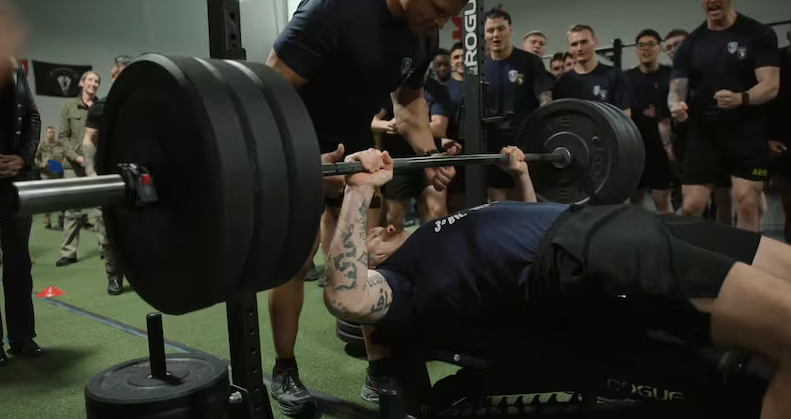
There was a moment when Pete Hegseth ALMOST FAILED to complete the 315lb bench press.
Yet he succeeded.
These are the moments that define masculinity, and they are what made Western civilization great.
We need more of them.pic.twitter.com/fFfaKJixSL
— The Conservative Alternative (@OldeWorldOrder) February 22, 2026
Behind the scenes, the Department of War oversaw a string of operations that reshaped perceptions of American military capability. The air campaign targeting Iran’s nuclear infrastructure, maritime interdictions of narcotics trafficking, the embargo enforcement against “dark fleet” oil shipments, and the capture of Venezuelan leader Nicolás Maduro marked a tempo and scope without clear historical parallels. Recruiting numbers rebounded. Public confidence in operational execution strengthened. Whether by design or coincidence, the timeline of reforms aligned with measurable outcomes.
Yet policy shifts alone did not generate the loudest controversy. A visit to Fort Campbell did. Hegseth reconnected with the 3rd Battalion, 187th Infantry Regiment—the Rakkasans—where he once served as an infantry platoon leader. In keeping with his now-familiar pattern, he joined troops for physical training. Cameras captured him bench-pressing 315 pounds.
What might have been a routine morale-building moment ignited a storm online. Social media critics questioned the weight, the technique, even the arithmetic. Some claimed the lift was exaggerated. Others argued the Secretary should remain insulated from such displays. A tabloid headline framed the moment as a reprimand of his son, who briefly moved to assist as a spotter.
Those familiar with weight rooms recognized a different dynamic. Standard spotting protocol requires the lifter to control the bar and signal when assistance is needed. As the bar descended and rose, Hegseth instructed his spotter not to intervene prematurely—an exchange typical in any gym. The lift counted as a single rep. The reaction, however, multiplied exponentially.
The symbolism was difficult to ignore. A Secretary of War pressing three plates per side, faltering slightly, then completing the repetition, became an unintended metaphor for his tenure. The episode underscored a broader point: leadership by example carries both motivational power and political risk. For supporters within the ranks, participation in physical training conveys solidarity. For critics, it offers a fresh angle of attack.

Hegseth’s emphasis on physical fitness has become central to his public image. He is frequently photographed running drills, engaging in PT sessions, and interacting directly with enlisted personnel. The visual message reinforces his stated objective: standards apply universally. If senior leaders demand readiness, they must embody it.