

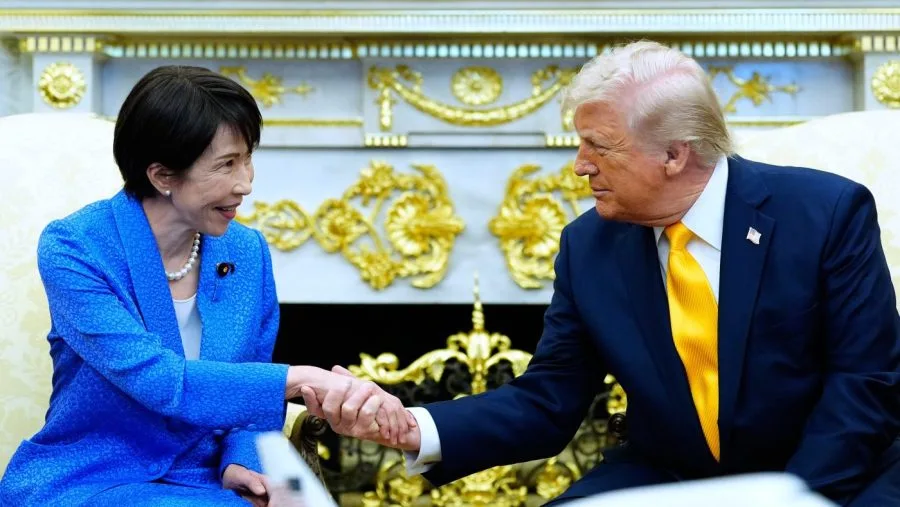

Japanese Prime Minister Sanae Takaichi’s recent visit to the United States concluded with a series of high-level engagements that underscored the strength and scope of the U.S.-Japan alliance. Meeting with President Donald Trump and attending an official White House dinner, Takaichi’s trip combined diplomatic signaling with substantive policy coordination across defense, energy, technology, and trade.
Speculation ahead of the այց centered on potential friction, particularly regarding Japan’s stance on Operation Epic Fury. However, Takaichi struck a conciliatory tone, stating that President Trump is uniquely positioned to bring stability to the situation. Her remarks reinforced alignment rather than division, setting the stage for a broader demonstration of bilateral cooperation.
Welcoming the Prime Minister of Japan to the White House. 🇺🇸🇯🇵
Two nations. One powerful alliance. pic.twitter.com/UfQrcZsNeY
— The White House (@WhiteHouse) March 20, 2026
A moment that drew attention came from a White House video highlighting the visit. During a tour of the Presidential Wall of Fame, Takaichi was shown a display featuring former President Joe Biden, represented by an autopen signature. The Prime Minister was seen laughing at the image, a clip that quickly circulated and fueled commentary about perceptions of Biden’s leadership during his final years in office.
Beyond optics, the visit produced a wide-ranging set of agreements and initiatives. Central to the economic agenda was a major expansion of Japanese investment in the United States. A second tranche of funding under the 2025 U.S.-Japan Strategic Trade and Investment Agreement includes up to $40 billion from GE Vernova Hitachi for small modular nuclear reactors in Tennessee and Alabama, alongside up to $33 billion in natural gas infrastructure projects in Pennsylvania and Texas. These investments align with broader efforts to reindustrialize key sectors of the U.S. economy while strengthening energy security.
Japan's PM reacts to autopen portrait of Joe Biden pic.twitter.com/zHXFHbk2Mj
— End Wokeness (@EndWokeness) March 20, 2026
The two nations also advanced cooperation on critical minerals, signing a Memorandum of Cooperation targeting deep-sea resource development near Japan’s Minamitorishima Island. A parallel Critical Minerals Action Plan aims to diversify supply chains and stabilize pricing mechanisms, reflecting growing concern over resource competition.
In technology and innovation, agreements were reached to deepen collaboration on artificial intelligence, quantum computing, and high-performance computing. Partnerships involving Argonne National Laboratory, RIKEN, Fujitsu, and NVIDIA will accelerate development in advanced computing systems. Additional coordination in biotechnology and pharmaceutical supply chains builds on the 2025 Technology Prosperity Deal.
When she saw the autopen 🤣 https://t.co/EULKkxlaR8 pic.twitter.com/etL6ll9BGu
— ALX 🇺🇸 (@alx) March 20, 2026
Defense cooperation featured prominently. Both countries reaffirmed commitments to regional stability, including maintaining a strong deterrence posture in the Indo-Pacific. Plans include expanded missile production, continued deployment of advanced U.S. systems in Japan, and deeper trilateral coordination with South Korea. The leaders also reiterated their position on Taiwan, emphasizing peaceful resolution and opposition to unilateral changes to the status quo.

Space exploration remains another pillar of cooperation. Joint efforts under NASA’s Artemis program will include Japan’s lunar rover, alongside upcoming missions such as the Nancy Grace Roman Space Telescope and the Martian Moons eXploration project.
The visit concluded with both leaders emphasizing long-term strategic alignment.