

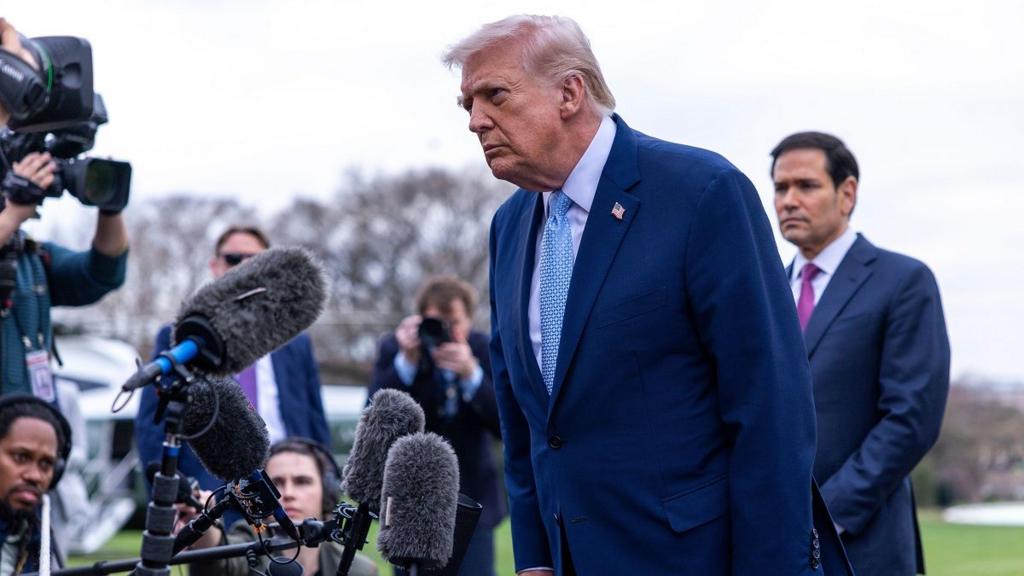

President Donald Trump signaled a potential shift in the escalating conflict with Iran, announcing early Monday that diplomatic progress may be underway while simultaneously pausing imminent military action. In a statement posted on Truth Social, Trump said recent discussions between U.S. and Iranian representatives had been “very good and productive,” pointing to what he described as movement toward a “complete and total resolution” of hostilities.
Acting on that assessment, Trump ordered a five-day postponement of planned U.S. strikes targeting Iranian power plants and energy infrastructure. The delay, he emphasized, is conditional and tied directly to the success of ongoing negotiations expected to continue throughout the week. The decision reflects a calculated pause in an otherwise aggressive military campaign that has defined the conflict’s first three weeks.
NEW: President Trump says that he's had "very good and productive conversations" with Iran over the weekend about a "complete and total resolution of our hostilities in the Middle East."
He has instructed the War Department to "postpone any and all military strikes against… pic.twitter.com/dHaL9PtsYo
— Mary Margaret Olohan (@MaryMargOlohan) March 23, 2026
The announcement follows heightened tensions after Iran threatened to target Israeli energy infrastructure and facilities supplying U.S. bases in the Gulf if Washington proceeded with strikes on its power grid. The exchange of threats underscored the risk of broader regional escalation, particularly as the Strait of Hormuz remains a focal point of strategic concern.
Despite Trump’s claims of active negotiations, Iranian state media denied that formal talks are taking place. Trump directly rejected those reports, stating that U.S. envoys, including Steve Witkoff and Jared Kushner, had engaged with Iranian counterparts as recently as Sunday night. Regional intermediaries appear to be involved as well, with Turkey maintaining communication channels and the United Arab Emirates actively responding to renewed Iranian attacks, including attempted interceptions of incoming fire.
Update from CENTCOM Commander on Operation Epic Fury: pic.twitter.com/8yTLrVy4jk
— U.S. Central Command (@CENTCOM) March 21, 2026
Global markets reacted immediately to Trump’s statement, with oil futures showing volatility amid uncertainty over supply stability and the potential for de-escalation. The economic dimension of the conflict continues to run parallel to military developments, particularly given the central role of the Strait of Hormuz in global energy transit.
"Iran's capabilities are declining..." - Adm. Brad Cooper, CENTCOM Commander pic.twitter.com/FC3TgpEGpJ
— U.S. Central Command (@CENTCOM) March 21, 2026
On the battlefield, U.S. Central Command reports a sustained and expansive campaign. According to Adm. Brad Cooper, U.S. forces have conducted more than 8,000 strikes on Iranian military targets, including the destruction of 130 naval vessels. The operation, described as the most rapid elimination of a naval force in a comparable timeframe since World War II, has significantly reduced Iran’s capacity to project power. Cooper stated that Iranian naval activity has effectively ceased, tactical air operations have halted, and missile and drone launch capabilities have been sharply degraded.
— Rapid Response 47 (@RapidResponse47) March 21, 2026
U.S. forces continue to maintain air superiority, executing thousands of combat sorties while targeting missile infrastructure and anti-ship capabilities along Iran’s coastline. Recent operations have focused heavily on neutralizing threats to maritime traffic, including precision strikes on hardened facilities linked to cruise missile deployment. Military leadership asserts that Iran’s ability to disrupt shipping through the Strait of Hormuz has been materially weakened but not fully eliminated.

International pressure is also intensifying. More than 20 nations have jointly condemned Iran’s actions targeting commercial shipping and energy infrastructure, warning that continued interference threatens global stability. Leaders including India’s Prime Minister Narendra Modi have called for de-escalation, emphasizing the broader economic and humanitarian risks associated with prolonged conflict.