


President Donald Trump said Spain reversed course on NATO-related payments after he threatened to cut off U.S. trade with the country, claiming the Spanish government ultimately agreed to make additional payments following a standoff over defense spending.
Speaking with reporters aboard Air Force One, Trump said Spain "came back all the way" after he directed Treasury Secretary Scott Bessent to halt U.S. trade with the European nation over its continued resistance to meeting NATO's defense spending target.
The dispute has been one of the most visible disagreements between the Trump administration and the government of Spanish Prime Minister Pedro Sánchez. Spain has maintained that its planned defense spending of 2.1 percent of GDP is sufficient to meet its obligations within the alliance, despite NATO's stated goal of five percent of GDP. Trump has repeatedly argued that member nations should contribute more toward their own defense rather than relying heavily on the United States.
Trump Threatens Trade Embargo with Socialist Spain over Iran Disputehttps://t.co/cyT3agJPa7
— Breitbart London (@BreitbartLondon) March 3, 2026
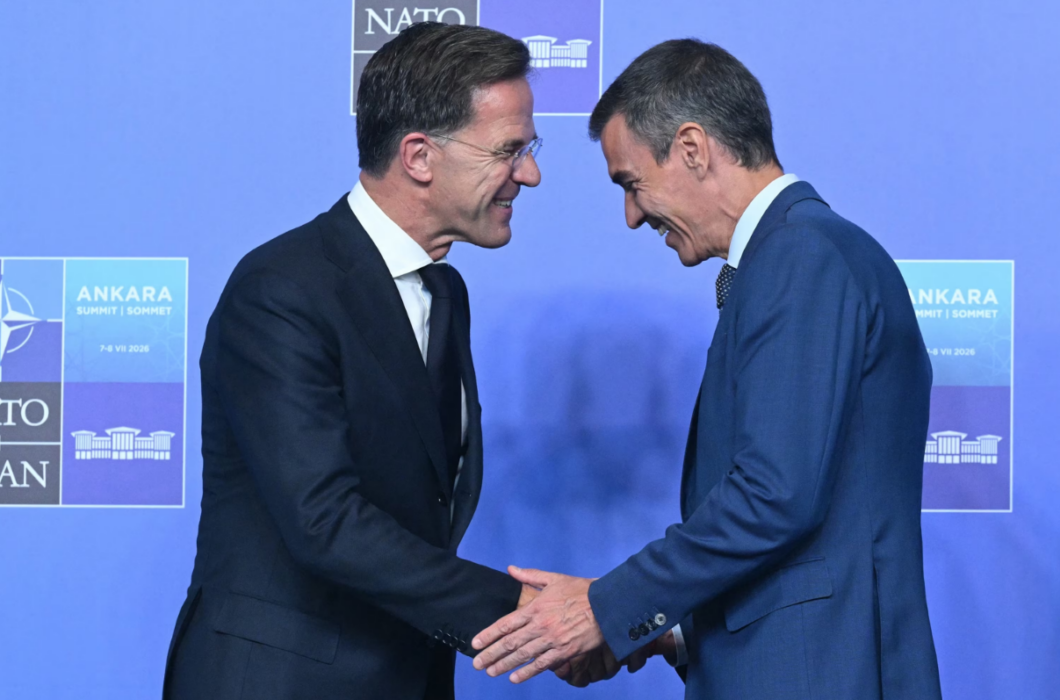
During the NATO Summit in Ankara, Turkey, Trump sharply criticized Spain's position, describing Sánchez's socialist government as a "lost cause" and suggesting the United States had no obligation to continue trading with a country that refused to increase its defense commitments. He predicted Spain would eventually change its position under economic pressure.
Hours later, Trump told reporters that his prediction had come true.
"Spain, I will say, I did have issues with Spain, and I still do, but Spain came back all the way today. Spain was very generous today. You know, I told them I'm going to stop trading," Trump said aboard Air Force One.
When asked what Spain had agreed to, Trump offered only a brief explanation.

"They honored a request for lots of payment — and if they didn't, we wouldn't even talk to them," he said.
Trump did not elaborate on the nature of the payments or provide additional details about any agreement. As of press time, the Spanish government had not publicly identified what commitments, if any, had been made in response to Trump's remarks.
.@POTUS: "I will say, I did have issues with Spain, and I still do, but Spain came back all the way today. Spain was very generous today... they honored a request for lots of payment—and if they didn't, we wouldn't even talk to them." pic.twitter.com/W8SawCuYuG
— Rapid Response 47 (@RapidResponse47) July 9, 2026
Earlier in the day, Prime Minister Sánchez acknowledged having an informal conversation with Trump after news of the trade halt directive emerged. According to Sánchez, the discussion was cordial and focused on topics unrelated to the dispute, including soccer and golf.

"We discussed soccer and the World Cup in the United States. It was an informal, casual conversation, completely free of any tension. On the contrary, it was characterized by cordiality and friendliness," Sánchez told reporters. "It took place after the press conference given by the President of the United States."
Sánchez also said his government first learned of the trade halt through media reports rather than through direct diplomatic communication. Despite the announcement, he said Spain intended to respond calmly and without escalating tensions.
"Because, ultimately, when you step back a bit from these kinds of statements, you see that the relationship between the United States and Spain — socially, culturally, economically, and politically — is very positive," Sánchez said.
📺 TV en DIRECTO | Sánchez: "He hablado con Trump de fútbol, ha sido una charla coloquial sin ninguna tirantez [...]. Cuando uno se aleja un poco de este tipo de declaraciones ve que nuestra relación es muy positiva […]. No es la primera vez que recibimos este tipo de crítica" pic.twitter.com/QTLV1ZElYJ
— EL PAÍS (@el_pais) July 8, 2026
Before Trump's comments aboard Air Force One, a spokesperson for the Spanish government reportedly told international media that officials were treating the trade halt announcement with patience and normalcy. The spokesperson also emphasized the longstanding economic relationship between the two countries, noting that the United States currently maintains a trade surplus with Spain.
While Trump declared the dispute largely resolved after Spain allegedly agreed to additional payments, the absence of publicly released details left unanswered questions about what, if anything, had formally changed.