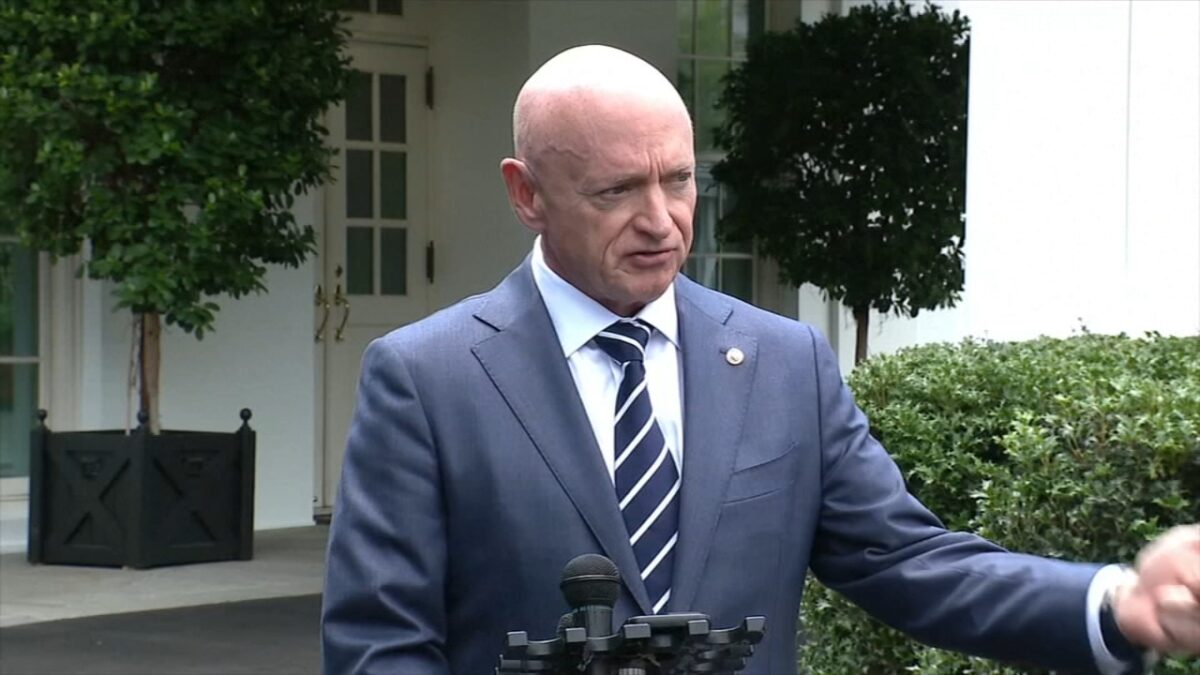

In a legal clash that tests the boundaries of military law, free speech, and the separation of powers, Senator Mark Kelly (D-AZ) has launched a bold lawsuit against War Secretary Pete Hegseth, Navy Secretary John Phelan, the Department of the Navy, and the War Department. Filed Monday in the U.S. District Court in Washington, D.C., the suit centers on an extraordinary constitutional confrontation — one that pits a sitting U.S. Senator and retired Navy Captain against the very military institution he once served.
At the heart of the dispute is Hegseth’s decision to initiate a Uniform Code of Military Justice (UCMJ) review targeting Kelly over his role in the controversial “Seditious Six” video. The video, released in late 2025, featured several high-profile veterans — including Kelly — discussing the need for active-duty service members to “evaluate the legality of their orders in real time.” For Hegseth and other Pentagon officials, that language crossed a dangerous line.
Pete Hegseth is coming after what I earned through my twenty-five years of military service, in violation of my rights as an American, as a retired veteran, and as a United States Senator whose job is to hold him—and this or any administration—accountable. His unconstitutional…
— Senator Mark Kelly (@SenMarkKelly) January 12, 2026
But for Kelly, the move represents a fundamental overreach of executive power. “Pete Hegseth is coming after what I earned,” Kelly wrote in a statement accompanying the lawsuit, framing the review not as an act of justice, but of political intimidation. He warned that allowing the Department of Defense to retroactively punish veterans for protected speech would create a chilling precedent — one that turns military service into a lifelong leash of government control.
Kelly’s argument rests on three pillars: constitutional protections for speech, the separation between military and civilian governance, and the rights of retired officers. Though technically still subject to the UCMJ due to his status as a retired, paid officer, Kelly insists that his comments fall squarely under protected political expression — not sedition. “Military rank is earned, not given,” he stated, invoking his own decorated record of service and sacrifice.
For Hegseth, however, the stakes are equally high. In a January statement, he claimed Kelly’s repeated public statements — spanning June to December 2025 — crossed from criticism into incitement. “Captain Kelly’s status as a sitting United States Senator does not exempt him from accountability,” Hegseth said. He cited Articles 133 and 134 of the UCMJ, which cover conduct unbecoming of an officer and general offenses, respectively, as the legal foundation for the review. In his words, Kelly’s conduct was “seditious in nature.”
Six weeks ago, Senator Mark Kelly — and five other members of Congress — released a reckless and seditious video that was clearly intended to undermine good order and military discipline. As a retired Navy Captain who is still receiving a military pension, Captain Kelly knows he…
— Secretary of War Pete Hegseth (@SecWar) January 5, 2026
Legal scholars will likely debate whether a retired officer’s public remarks can be prosecuted under the same standards as active-duty personnel — and whether that authority holds up when the officer in question is also an elected official tasked with oversight of the very department pursuing him. The implications are vast. If Kelly’s suit fails, it could open the door to broader enforcement of military codes on retired service members, particularly those who remain in the public eye. If he succeeds, it may limit the military’s power to discipline its former ranks long after their uniforms are hung up.
One thing is clear: this is no ordinary civil dispute. It's a collision of authority, loyalty, and constitutional interpretation — all under the shadow of America’s evolving civil-military balance.