

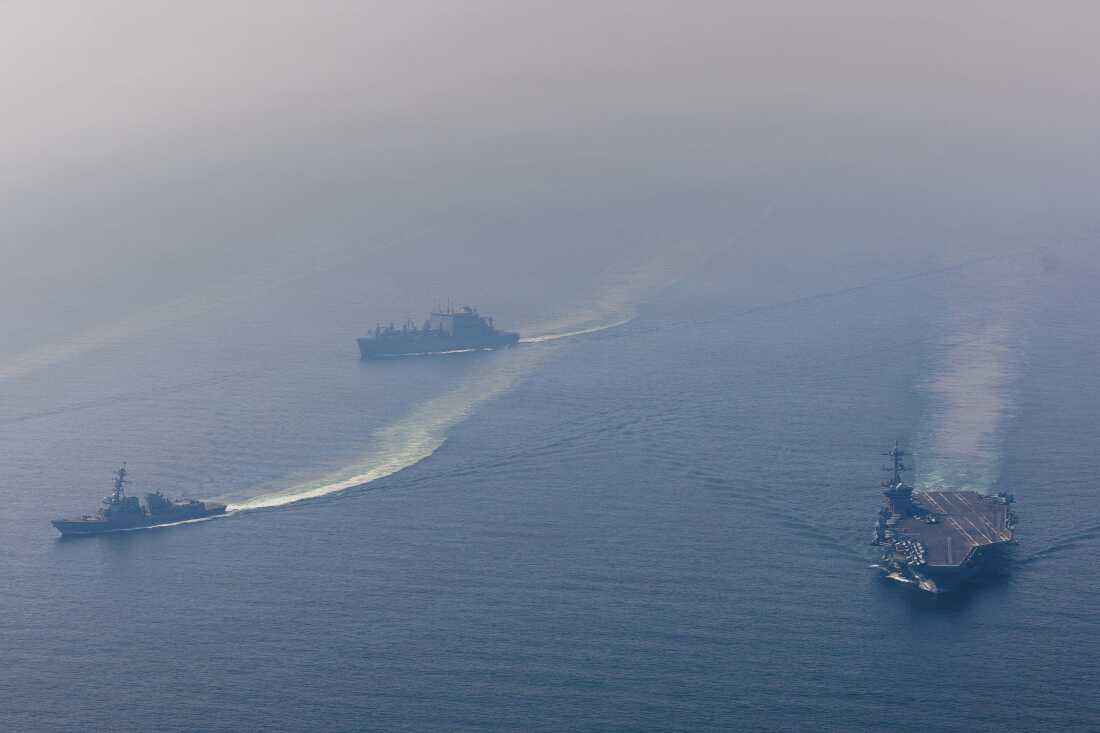

The announcement came with a sharp edge: assistance, not aggression, but backed by a clear warning. On Sunday, President Donald Trump introduced what he called “Project Freedom,” a plan to help commercial ships stranded in the Persian Gulf move safely through the Strait of Hormuz starting Monday morning. He framed it as a humanitarian move, but the message carried an unmistakable condition—any interference from Iran would trigger a response.
The Strait of Hormuz is not just another waterway. A significant share of the world’s seaborne oil passes through that narrow corridor, along with fuel and fertilizer shipments that supply multiple continents. When traffic stalls there, the ripple effects move quickly, tightening supply chains and raising costs. The stakes are immediate and measurable.

Iran’s reaction was swift. Ebrahim Azizi, a member of the Iranian parliament’s national security committee, argued that the U.S. effort would violate an existing ceasefire. The claim rests on a fragile premise.
Assisting ships through a contested route does not, on its own, constitute an attack. The dividing line appears clear: if U.S. forces are fired upon while carrying out the operation, the ceasefire would be broken by the side initiating that action.
Behind the scenes, coordination is already underway. U.S. officials describe a network involving governments, shipping companies, and insurance firms, all working to move vessels out of the region without escalation. U.S. Central Command confirmed its role, stating the mission is aimed at restoring freedom of navigation while maintaining a defensive posture.
🚫 CLAIM: Iranian state media claims that Iran's Islamic Revolutionary Guard Corps hit a U.S. warship with two missiles.
✅ TRUTH: No U.S. Navy ships have been struck. U.S. forces are supporting Project Freedom and enforcing the naval blockade on Iranian ports. pic.twitter.com/VFxovxLU6G
— U.S. Central Command (@CENTCOM) May 4, 2026
Guided-missile destroyers, more than 100 aircraft, unmanned systems, and roughly 15,000 service members are part of the support structure. Yet officials have been careful to draw a distinction: this is not a traditional escort mission. Instead, naval forces will remain nearby, ready to respond, while providing intelligence on safer routes—particularly paths that avoid suspected Iranian mine placements.
Complicating the situation further, Iranian state-linked media circulated claims that missiles struck a U.S. vessel near the port of Jask. CENTCOM rejected the report outright, with spokesman Capt. Tim Hawkins stating there was no truth to it. No evidence has surfaced to support the allegation.