

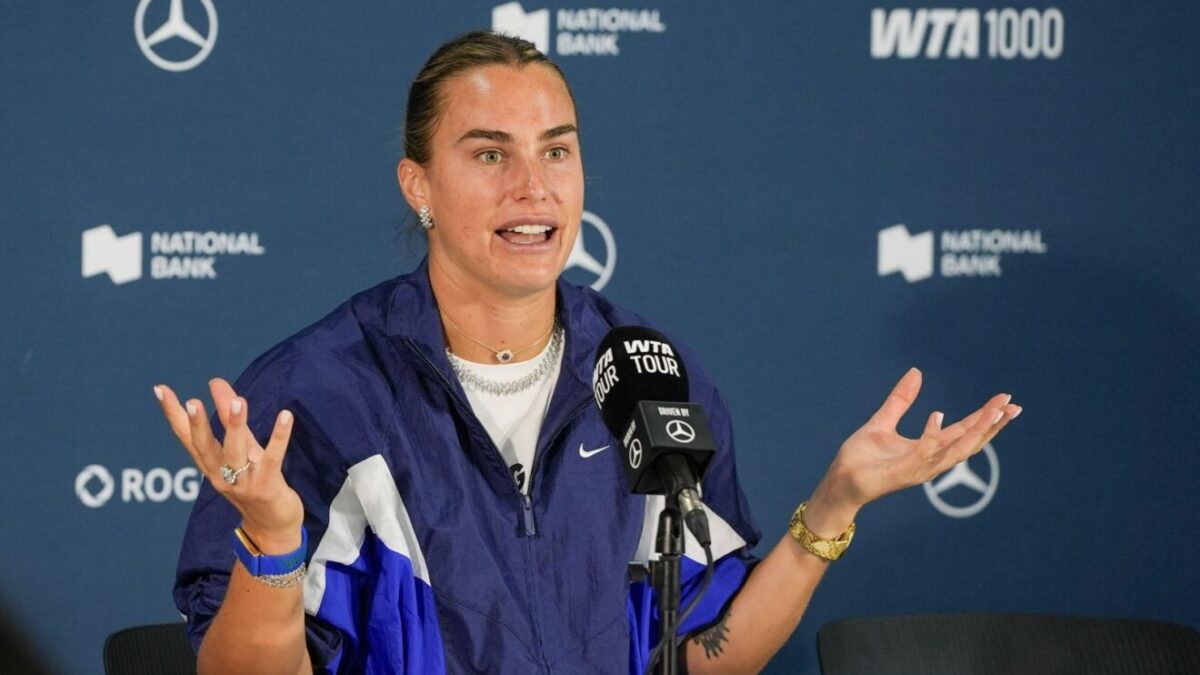

Aryna Sabalenka, the No. 1-ranked women’s tennis player in the world and a four-time Grand Slam champion, has publicly backed the Women’s Tennis Association’s new genetic testing requirements, saying the policy is an appropriate way to preserve competitive fairness in women’s tennis.
Speaking during a press conference at the Canadian Open, the Belarusian star said she believes biological differences between men and women make mixed competition unfair at the highest levels of the sport.
“Biologically, men are way stronger than women, so I feel like it would not really be fair for women to compete against biological men,” Sabalenka told reporters.
🚨Aryna Sabalenka on newly introduced sex testing by the WTA:
“I support it. If they want to test us all, I'm happy to do that."
Boom. 💥
Thank you @SabalenkaA pic.twitter.com/WqLN9NpYfX
— Jennifer Sey (@JenniferSey) August 4, 2026
She also made clear that she has no objection to the new screening process applying to every player.
“If they want to test us all, I'm happy to do that. It's pretty fair, and let's keep it that way.”
Her comments place one of the biggest names in women’s tennis alongside a growing number of female athletes who have spoken publicly about eligibility rules in women’s sports. Among them is Indiana Fever guard Sophie Cunningham, who recently argued that women’s competitions and locker rooms should remain limited to biological females.
Sabalenka’s position carries additional weight because she has firsthand experience competing in a highly publicized exhibition against a male professional player. In December 2025, she faced Nick Kyrgios in a "Battle of the Sexes" event in Dubai. Kyrgios entered the exhibition with an ATP ranking of No. 671, but the match was designed with several rule modifications intended to reduce his natural advantages.

Those adjustments included removing Kyrgios’ serve, one of the strongest weapons in men’s tennis. Sabalenka’s side of the court was also reduced by approximately nine percent, an accommodation based on average movement-speed differences between male and female players.
And that's all she wrote!
Nick Kyrgios defeats Aryna Sabalenka to win the Battle of the Sexes 👏 pic.twitter.com/9Yysdt6F5V
— Tennis Channel (@TennisChannel) December 28, 2025
Even with those changes, the exhibition reignited discussion about the physical differences between elite male and female athletes. For many observers, the unusual rule modifications themselves illustrated why direct competition between the sexes remains controversial.
Former professional player and ESPN tennis analyst Patrick McEnroe weighed in after the exhibition. McEnroe said he believed he could “easily” defeat Sabalenka if they played a genuine match despite being 60 years old. He also suggested that the world's top 17-year-old junior boys would likely beat the women’s world No. 1 by a lopsided score.

“I don’t say that to denigrate women’s tennis,” McEnroe added. “I love women’s tennis.”
Those remarks sparked further debate, but they also reflected a broader discussion about the physical distinctions between men's and women's competition that has increasingly become part of conversations across multiple sports.
— welovesports40 (@welovesports40) April 4, 2026
Cunningham has generated similar attention in basketball after making her own position clear.
“I want to protect young girls in a locker room, or young girls in sport who shouldn't have to go against biological men,” she said.
With Sabalenka now voicing support for the WTA’s testing policy, two of the most recognizable female athletes in professional sports have publicly endorsed eligibility standards based on biological sex. Their comments come as governing bodies across the sports world continue to revisit participation rules, balancing questions of inclusion with concerns about competitive fairness.