

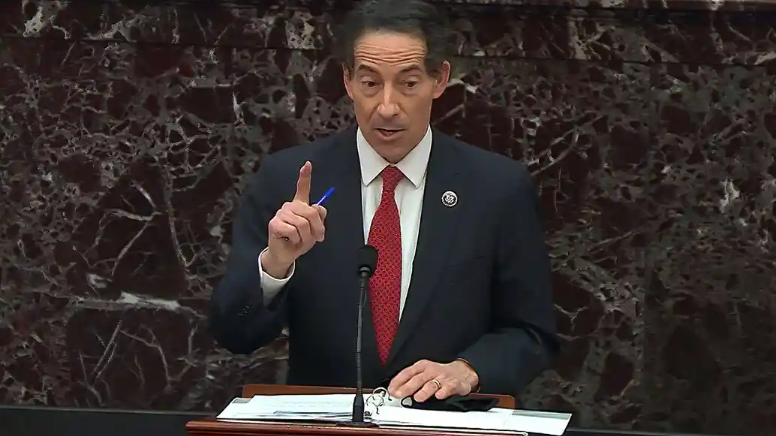

Rep. Jamie Raskin’s defense of Del. Stacey Plaskett on the House floor this week may go down as one of the most astonishing—and tone-deaf—moments in recent congressional memory. As Republicans introduced a resolution to censure Plaskett for her 2019 text exchanges with Jeffrey Epstein during a live House hearing, Raskin took to the floor not with facts, but with an excuse that was as flimsy as it was insulting: she was just “taking a phone call from her constituent.”
The backlash was immediate—and brutal. Raskin, who once held a reputation for scholarly precision, seemed to abandon all credibility with a line that tried to reduce a documented exchange with a convicted sex offender into a casual constituent service moment. The reaction was swift from all corners of the political sphere, with independent journalist Lee Fang calling the claim “incredibly dishonest” and others describing Raskin’s spin as “sick.”
And let’s be clear: this wasn’t just a random phone call. This was a coordinated exchange during a live House Oversight Committee hearing—one of the most high-profile testimonies of the Trump era—where Plaskett, a delegate from Epstein’s home turf in the U.S. Virgin Islands, appeared to be working off prompts sent directly from Epstein himself. This isn’t conjecture. This is documented, timestamped, and disturbingly direct.
Yet Raskin framed it as a constitutional issue. “Are we saying just because they were on a phone call, they're guilty of something?” he asked. No, Congressman. What’s being said is that Plaskett had a long and murky history with a convicted predator—including work for his fixer, campaign contributions from his network, and a role in facilitating sweetheart tax deals—and was caught coordinating with him during a federal hearing. That’s not due process denial. That’s public accountability.
Even more remarkable was Plaskett’s own defense. From the House floor, she claimed there was no “public knowledge” of Epstein’s federal investigation at the time, as if that exonerates the impropriety of texting him during a hearing. That excuse falls apart under even the lightest scrutiny. Epstein had already served time in 2008, was a registered sex offender, and was widely known as a political and legal pariah by 2019.
And then there’s the context laid out by Lee Fang—who is not exactly a conservative firebrand. He’s reported in detail that Plaskett had long-standing financial and professional ties to Epstein. She worked with the law firm that smoothed his tax operations. She helped him obtain favorable deals from the Virgin Islands government. She took campaign cash. She shook hands, traded favors, and now insists it was just “constituent communication.”
This wasn’t a one-time text. It was part of a pattern. And Raskin’s defense—framed as if this were just an innocent moment twisted by political motives—doesn’t just stretch the truth. It insults the intelligence of everyone watching.

The censure vote ultimately failed. But the record is now clear. The House had the opportunity to draw a line and signal that coordination with a convicted sex trafficker during a congressional hearing is unacceptable, regardless of party affiliation. It didn’t.
What remains is a trail of excuses, spin, and a growing cloud of questions—questions not just about Stacey Plaskett, but about the Democratic leadership’s discomfort with where the Epstein Files might lead.