

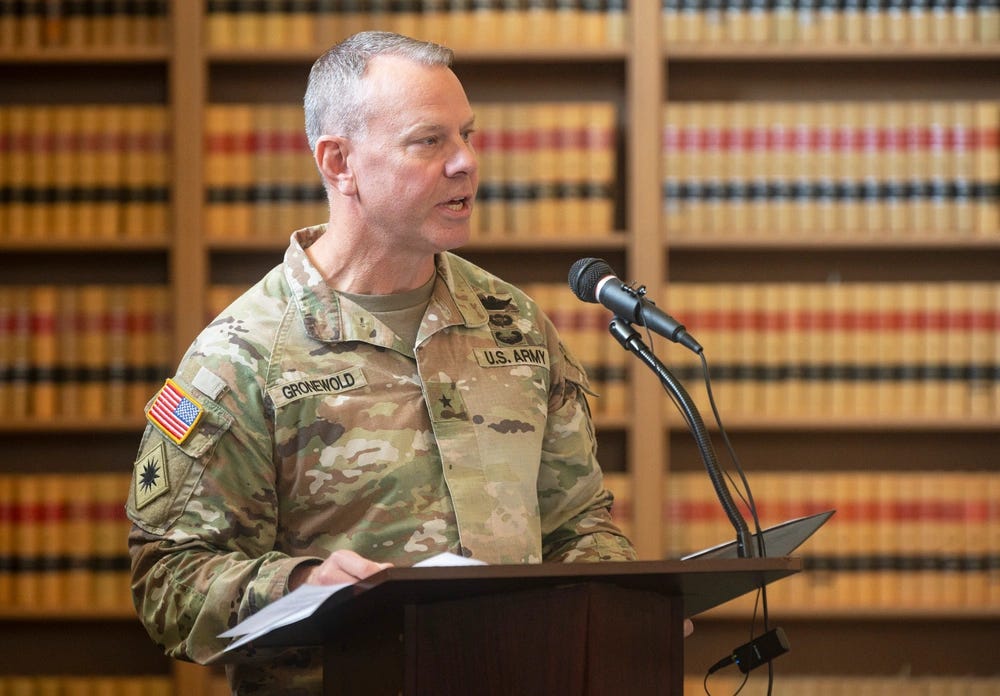

In a state already known for its strained relationship with federal authority, Oregon’s top military official delivered a sobering and candid message to the Oregon National Guard this week. The memo came as President Donald Trump followed through on his controversial plan to federalize 200 National Guard troops and deploy them to Portland under Title 10 orders — a move framed by the administration as a necessary step to protect federal personnel and facilities amid ongoing unrest and resistance.
Brigadier General Alan R. Gronewald, Oregon’s adjutant general, acknowledged the complexity and tension of the moment in his message to service members, balancing duty with empathy. “I know some of you may have strong feelings about this mission. That’s okay,” he wrote, before reminding troops of their oath to follow lawful orders, even when personally conflicted. “We don’t get to pick and choose. We execute lawful orders with professionalism and honor, period.”
Gronewald’s memo emphasized the scope and limitations of the operation: once under Title 10, the guardsmen answer not to the state of Oregon or Gov. Tina Kotek, but to U.S. Northern Command and the Commander-in-Chief. That chain of command shift, now the subject of a legal challenge by Oregon Attorney General Dan Rayfield, adds fuel to a growing political firestorm — one that now includes a restraining order request, a lawsuit, and opposition from 17 Oregon mayors.
While the legal and political chaos unfolds, Gronewald’s focus was squarely on the men and women in uniform. He urged soldiers to prepare their families, stay in touch with their civilian employers, and remain smart on social media. “Understand you represent something bigger than yourself,” he said, warning against online political arguments and reminding soldiers that “the public is watching.”
This deployment is only the latest flashpoint in a long-simmering feud between Oregon’s Democratic leadership and President Trump’s aggressive use of federal authority. What began with threats of intervention this summer evolved into full federalization after months of protest activity near Portland’s ICE facility. Although crowd sizes had diminished since June, Trump’s repeated characterization of Portland as a city “under siege” and “burning every night” became a central talking point in his broader campaign to target Democrat-run cities as case studies in urban failure.
The timeline leading up to the mobilization paints a picture of escalation. It started with policy talk and ICE arrests in the summer, followed by public marches and federal law enforcement surveillance. Then came warnings of troop deployments, secretive agent movements, and now — the arrival of National Guard forces in a city that’s seen its share of flashpoints over the past few years.
Gronewald’s message, though couched in military discipline, made no attempt to sugarcoat the potential fallout: “Some people in Oregon won’t understand or won’t support this mission. Some might even be hostile about it.” His message was not one of glorifying the mission, but of reaffirming the identity of the National Guard — professionals who serve, regardless of popularity or optics.

And in the final lines, he offered a grounded reminder of who these soldiers are: “We are the Oregon National Guard — Citizen-Soldiers and Airmen who serve where we live. We've been doing this for over 150 years, through wars, disasters, and everything in between.”