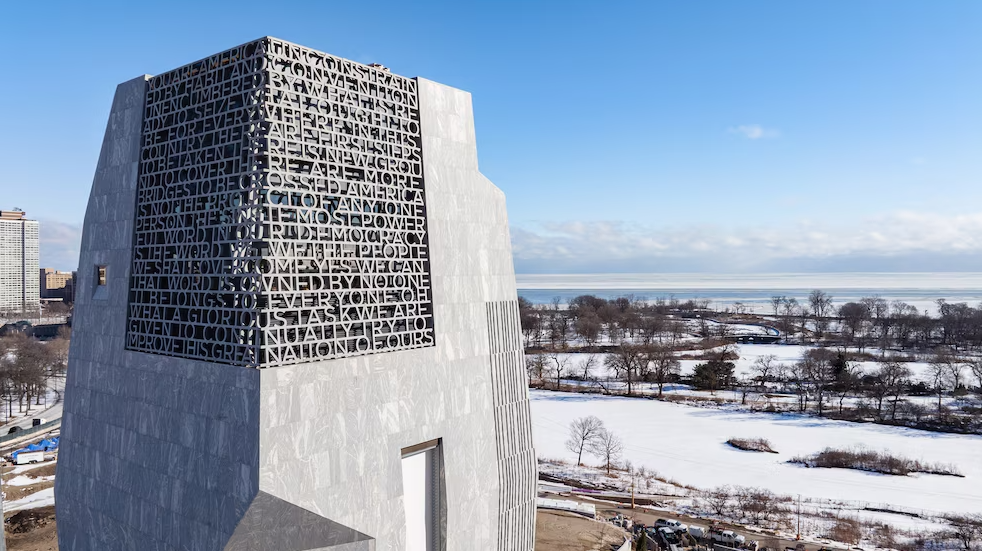

Barack Obama’s long-anticipated presidential center in Chicago is finally approaching its opening date, but the project is already drawing attention for reasons that extend far beyond its role as a traditional presidential library. From its stark architectural design to the political symbolism surrounding it, the building has become a lightning rod for critics who see it as an embodiment of Obama’s controversial legacy.
Architecturally, the structure has sparked debate since the first renderings were released. The building’s monolithic, rectangular form rises dramatically above Jackson Park, with many observers comparing its appearance to austere government buildings from another era. Critics have described it as imposing, even bleak, arguing that the design feels less like a welcoming public institution and more like a fortress of concrete and glass. When additional elements—such as large inscriptions of Obama’s own words—were added to the exterior plans, the reactions only intensified.
Today, Michelle and I are proud to announce that we will be hosting the dedication ceremony for the Obama Presidential Center on June 18th in Chicago, and welcoming the public on June 19th.
We can’t wait for you to visit. Go to https://t.co/swMRHuB5Y4 to learn more. pic.twitter.com/8mcbWjs6cz
— Barack Obama (@BarackObama) March 7, 2026
Supporters argue that the inscriptions are intended to connect the center to the broader arc of American civil rights history. Obama has said that words drawn from his speeches, particularly those referencing the Selma marches, are meant to honor the sacrifices of civil rights leaders who helped reshape the nation. But detractors see the decision differently. To them, placing the words of a modern political figure prominently on the exterior of the building risks shifting attention away from the historical figures being commemorated and toward the legacy of the president himself.
Congrats to Chicago’s south side! Yeah, you need schools and housing. Yeah you need jobs. Yeah you need respect. But here. Take this giant concrete building instead. You’re welcome! Signed - The Obamas https://t.co/RTDqdeMMBI
— Kira (@Kiradavis) March 7, 2026
The controversy surrounding the building extends beyond its design. Construction of the Obama Presidential Center has faced criticism from local activists and community groups who challenged the project in court. Lawsuits questioned the use of public parkland and raised concerns about potential impacts on the surrounding neighborhoods. Although those legal battles were ultimately unsuccessful, they fueled broader debates about the project’s cost and its role in the community.
you have seen what it looks like right? https://t.co/UzJNySGzUF
— Sean Spicer (@seanspicer) March 7, 2026
Budget concerns have also lingered. Reports indicate the project has run significantly over initial cost projections, a development that critics argue reflects poor planning and financial oversight. For supporters, however, the center represents a long-term investment intended to draw tourism, educational programming, and economic activity to Chicago’s South Side.
https://t.co/KVnp9fENub pic.twitter.com/BgcIO8EPsg
— James Woods (@RealJamesWoods) March 7, 2026
Obama recently promoted the upcoming opening, scheduled for June, thanking Chicago residents and declaring that “hope is coming home.” The phrase echoes the hopeful rhetoric that defined much of his political brand during the 2008 campaign and his presidency.
Yet the political reaction remains sharply divided. Admirers view the center as a landmark honoring the first African-American president and the broader ideals of civic engagement and public service. Critics, on the other hand, see it as a monument to a presidency they believe deepened political divisions and left unresolved foreign policy and domestic challenges.