

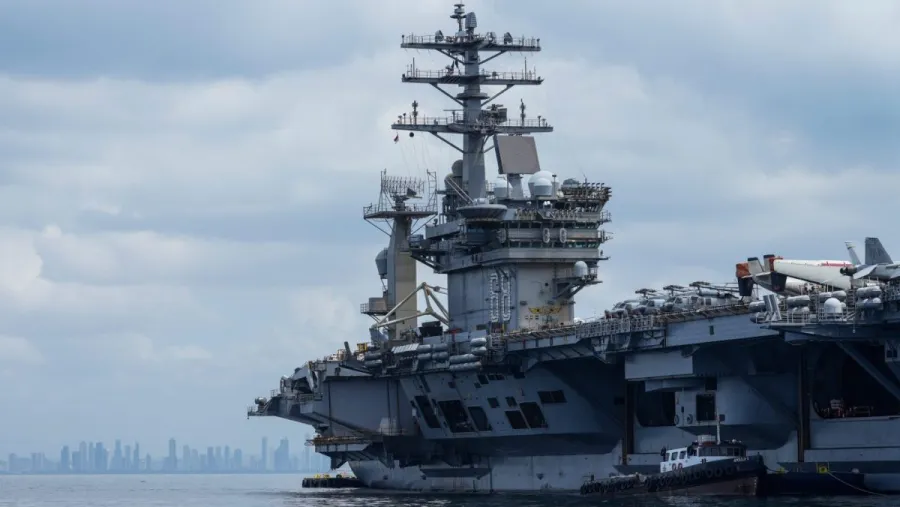

The arrival of the USS Nimitz Carrier Strike Group in the Caribbean this week is turning heads across the region, especially in Havana, where Cuba’s aging communist leadership now finds itself staring at one of the most powerful naval formations on Earth sitting uncomfortably close to home.
Officially, the deployment was planned well in advance. Militaries schedule these operations months ahead, sometimes years. But timing matters, and the timing here is difficult to ignore. Relations between Washington and Havana have sharply deteriorated under renewed pressure from the Trump administration, and the sight of a nuclear-powered aircraft carrier operating near Cuba sends a message that requires no translation.
Welcome to the Caribbean, Nimitz Carrier Strike Group!
The aircraft carrier USS Nimitz (CVN 68), the embarked Carrier Air Wing 17 (CVW-17), USS Gridley (DDG 101) and USNS Patuxent (T-AO 201) are the epitome of readiness and presence, unmatched reach and lethality, and strategic… pic.twitter.com/83mfzSIKzd
— U.S. Southern Command (@Southcom) May 20, 2026
The USS Nimitz is not arriving alone. The carrier is accompanied by Carrier Air Wing 17, including F/A-18E Super Hornets, EA-18G Growlers, and C-2A Greyhounds, along with the guided missile destroyer USS Gridley and the replenishment oiler USNS Patuxent. U.S. Southern Command described the strike group as the “epitome of readiness and presence, unmatched reach and lethality, and strategic advantage.”
That kind of language is not accidental.
For Cuba’s ruling Communist Party, this display has to be unsettling. The regime has survived for decades through isolation, propaganda, and careful geopolitical balancing between hostile and friendly powers. But watching a combat-proven American carrier group patrol nearby waters while tensions escalate politically is another matter entirely.
The military deployment coincides with a dramatic legal move from Washington. The United States formally indicted Raul Castro, Fidel Castro’s 94-year-old brother, over allegations tied to the 1996 shoot-down of two civilian aircraft operated by Brothers to the Rescue, a Miami-based exile organization. The attack killed three American citizens and one permanent U.S. resident.
Acting Attorney General Todd Blanche delivered a blunt warning alongside the indictment: “The United States and President Trump does not and will not forget its citizens.”

That statement landed at the same moment the Nimitz arrived in the region.
Meanwhile, the administration has steadily tightened the screws on Cuba’s economy. Oil shipments have been restricted. Sanctions have intensified. President Trump even joked publicly earlier this month that he might “take over” Cuba immediately, comments that were brushed off by some observers but almost certainly monitored closely in Havana.
Somewhere between Buenos Aires and Rio de Janeiro on May 10, the aircraft carrier USS Nimitz became the longest-serving flattop in Navy history.
USS Nimitz, which was commissioned on May 3, 1975, has been in active service for 51 years, longer than USS Enterprise.
Read about… pic.twitter.com/QSdVD5C4jS
— Stars and Stripes (@starsandstripes) May 20, 2026
Adding another layer to the situation is Secretary of State Marco Rubio, a Cuban-American politician who has spent years openly criticizing the Cuban regime. Rubio has consistently pushed for harder policies toward Havana and has shown little interest in returning to the softer diplomatic posture seen under previous administrations.
The USS Nimitz itself carries historic weight. Commissioned in 1975, the carrier recently became the longest-serving active aircraft carrier in U.S. Navy history, surpassing the legendary USS Enterprise. After more than five decades in service, the warship remains a centerpiece of American naval power.