

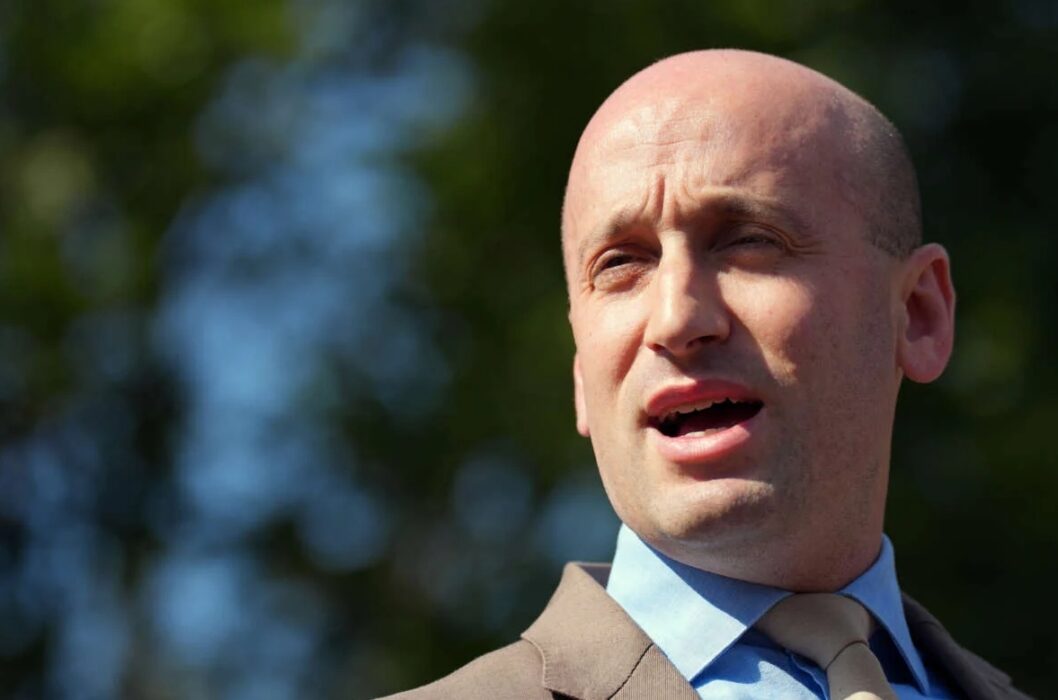

On Monday, White House Deputy Chief of Staff Stephen Miller stepped into an unfamiliar role—one of raw emotion and visible grief—as he joined Vice President JD Vance to co-host The Charlie Kirk Show, in tribute to their late friend and colleague. But what began as a solemn remembrance quickly evolved into something more—a public vow, forged in sorrow, to confront what Miller called the “vast domestic terror movement” that he believes is responsible for Kirk’s assassination.
The conversation was sobering, heavy with personal loss and political urgency. Miller, known for his sharp intellect and policy precision, spoke from a place of unmistakable anguish. He recounted the final message Kirk had sent him—just one day before his death. It was, Miller said, a clear directive: develop a strategy to go after the left-wing organizations promoting violence in this country.
That message, brief but powerful, now forms the cornerstone of what Miller is calling a long-overdue reckoning. “I will write those words onto my heart and I will carry them out,” he promised. His voice, breaking at times, made clear that this was more than rhetoric—it was a personal mission.
Miller's comments came amid growing national unrest following a series of politically and ideologically motivated attacks—some of them reportedly involving trans-identifying individuals targeting religious institutions and conservative public figures. One such shooting, at a Catholic mass in late August, left two children dead. Another, in Nashville two years ago, targeted a Christian school. The Justice Department has reportedly been exploring restrictions on gun purchases for certain high-risk demographics, with debate now renewed in the wake of Kirk’s death.
But Miller went further, warning not just about isolated incidents, but about a coordinated campaign of ideological violence—fueled by online mobs, doxxing networks, and cultural institutions that elevate dehumanization and vilification.
“The organized doxxing campaigns. The organized riots. The organized street violence,” he said. “These aren’t just isolated acts—they are the operations of a domestic terror movement.”
His solution: an aggressive, sweeping mobilization across federal agencies—DOJ, Homeland Security, and beyond—to dismantle what he called the infrastructure of ideological terror. “With God as my witness,” Miller vowed, “we are going to use every resource we have… to identify, disrupt, dismantle, and destroy these networks.”

And if the emotional weight of his on-air remarks wasn’t enough, Miller’s online post the day after Kirk’s death made the ideological battle lines unmistakable. He described a rising belief system that “hates everything that is good, righteous and beautiful,” that targets the family unit, elevates criminality, and celebrates destruction for its own sake.
“It is an ideology,” he wrote, “whose one unifying thread is the insatiable thirst for destruction.”
Miller's rhetoric marks a shift—from grief to confrontation, from mourning to mobilization. The tragic loss of Charlie Kirk, a towering figure in the conservative youth movement, appears to have crystallized a new moment of purpose for the inner circle of the Trump-Vance administration. Not just in policy, but in posture.
“We devote ourselves, with love and unyielding determination,” Miller concluded, “to finishing the indispensable work to which Charlie bravely devoted his life and gave his last measure of devotion.”
It is no longer merely about honoring Charlie Kirk’s legacy—it’s about waging the fight he foresaw, and finishing what he started.