

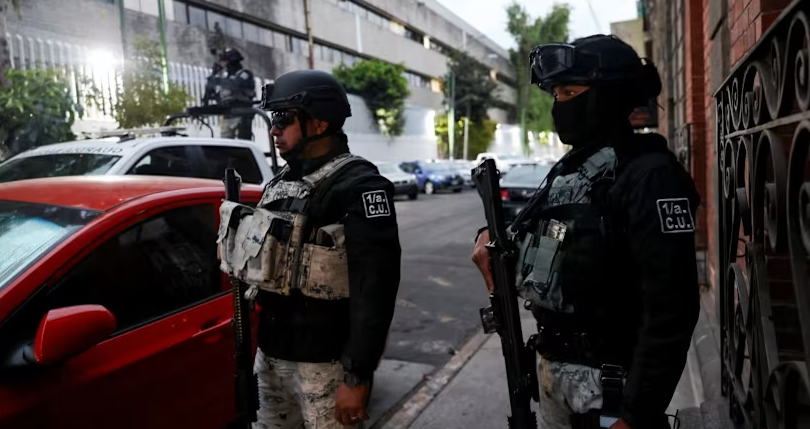

For years, Nemesio “El Mencho” Oseguera Cervantes stood as one of the most powerful and elusive cartel leaders in the Western Hemisphere. On Sunday, that reign ended in a hail of gunfire — and what followed looked less like a law enforcement action and more like a war zone.
Mexican special forces carried out the daring operation that killed the Jalisco New Generation Cartel (CJNG) boss, seizing an arsenal that underscores just how militarized the cartel had become. Among the weapons recovered were rocket launchers capable of shooting down aircraft, armored vehicles, and battlefield-grade firepower rarely seen outside active combat zones.
The operation, centered in Tapalpa, involved coordinated support from the Mexican Air Force and National Guard. Although led by Mexican authorities, the mission was informed by a U.S. military-led intelligence task force. According to reports, a detailed dossier compiled with U.S. intelligence was handed over to Mexican officials ahead of the strike. “El Mencho” had long topped American target lists, with a $15 million reward offered for information leading to his capture.
The presence of rocket-propelled weaponry was not symbolic. More than a decade ago, CJNG operatives used a rocket-propelled grenade to shoot down a Mexican military helicopter — a brazen demonstration of the cartel’s reach and firepower. In 2023, then–Mexican Defense Secretary Luis Cresencio Sandoval confirmed that multiple rocket launchers had already been seized from CJNG stockpiles. Sunday’s discoveries reinforced the scale of the threat.
“El Mencho,” a former police officer turned cartel mastermind, was injured during the firefight as security forces attempted to apprehend him. Several officers were also wounded in the exchange. His death marked the end of a violent empire built on trafficking fentanyl, methamphetamine, and cocaine into the United States — narcotics that have fueled record overdose crises north of the border.
But the cartel’s response was immediate and ferocious.
As news of his death spread, CJNG gunmen launched retaliatory attacks across multiple states. Highways were blockaded. Vehicles were torched. Businesses went up in flames. Puerto Vallarta — a resort city known more for beaches than barricades — fell into chaos.

“It looked like the whole city was on fire,” said Scott Posilkin, a Colorado tourist stranded in the area.
Another traveler described Puerto Vallarta as a “demolition zone.” Video from Guadalajara’s airport showed panicked travelers running for safety. Major airlines, including United, American, and Air Canada, suspended flights into Puerto Vallarta. Flights into Guadalajara were halted as well.
In Tepic, a woman identified only as Priscilla described watching cartel members ignite cars while she was unable to reach her son due to shelter-in-place orders. Reports of violence also emerged from Michoacán, Tamaulipas, Colima, Guanajuato, Aguascalientes, and Veracruz — a coordinated show of force meant to signal that CJNG’s power did not die with its leader.
Now, attention turns to what comes next.
“El Mencho controlled everything,” said Mike Vigil, former chief of international operations for the DEA. “He was like a country’s dictator.”
His death may fracture the cartel’s command structure — or it could unleash something more volatile. Security analyst David Saucedo warned of potential “indiscriminate violence” as factions compete for control.
The raid that eliminated one of the world’s most wanted drug lords was decisive.