

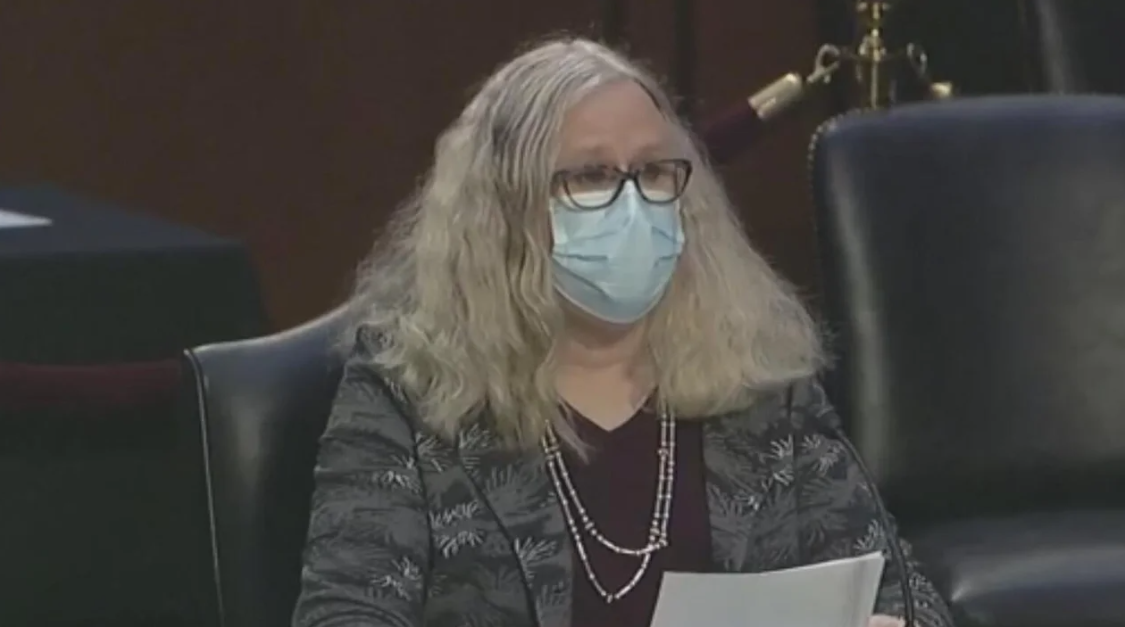

The Department of Health and Human Services (HHS) has sparked a firestorm by altering the official nameplate of Biden-era health official Rachel Levine to reflect Levine’s birth name, Richard Levine — a decision that has ignited fierce debate across political and cultural lines.
The change, which took place during the recent Democrat-led government shutdown, was first noticed when the portrait plaque displayed in the HHS offices was quietly updated. While it might seem like a simple act of bureaucratic reversion, the implications are anything but minor. In an era where identity and policy often collide, this move by the current HHS leadership has been interpreted as a statement — one that pulls no punches.
Levine, who served as the Assistant Secretary for Health and made headlines as the first openly transgender four-star officer in U.S. history, quickly denounced the change as “petty” and emblematic of “bigotry.” Though he declined to elaborate directly in comments to NPR, his spokesperson, Adrian Shanker, issued a scathing response: “During the federal shutdown, the current leadership of the Office of the Assistant Secretary for Health changed Admiral Levine’s photo to remove her current legal name and use a prior name… this is bigotry against her.”
Can confirm! https://t.co/PdErnBJVqh pic.twitter.com/yuZGMfK6xw
— HHS (@HHSGov) December 9, 2025
But the current HHS team stood firmly behind the decision. “Our priority is ensuring that the information presented internally and externally by HHS reflects gold standard science,” spokesman Andrew Nixon said, adding that the department remains committed to “reversing harmful policies enacted by Levine” and anchoring public health in “biological reality.”
That final phrase — biological reality — marks a dramatic shift in tone from Levine’s tenure, during which HHS became a national lightning rod for its promotion of gender ideology in medicine. Levine was both praised and criticized for championing transgender health initiatives, especially those related to minors. His claim to the title of “first female four-star officer” sparked controversy, particularly among critics who argued that biology was being sidelined in favor of identity politics.
Levine’s efforts also extended into the digital realm. In 2022, he delivered remarks urging the medical community to pressure tech platforms to suppress what he labeled “misinformation” about gender-affirming care. “We need to use our clinicians’ voice to collectively advocate for our tech companies to create a healthier, cleaner information environment,” he said.
That statement, and others like it, raised concerns among free speech advocates, who questioned whether government officials should be involved in pushing private companies to control public discourse.

The current HHS leadership’s decision to revert Levine’s nameplate may be a symbolic gesture, but it’s clearly a calculated one. It signals not only a break from the past administration’s policies but also a broader pivot in how the department intends to frame its public health messaging moving forward — with a renewed emphasis on scientific standards rooted in biological definitions, rather than sociopolitical constructs.