

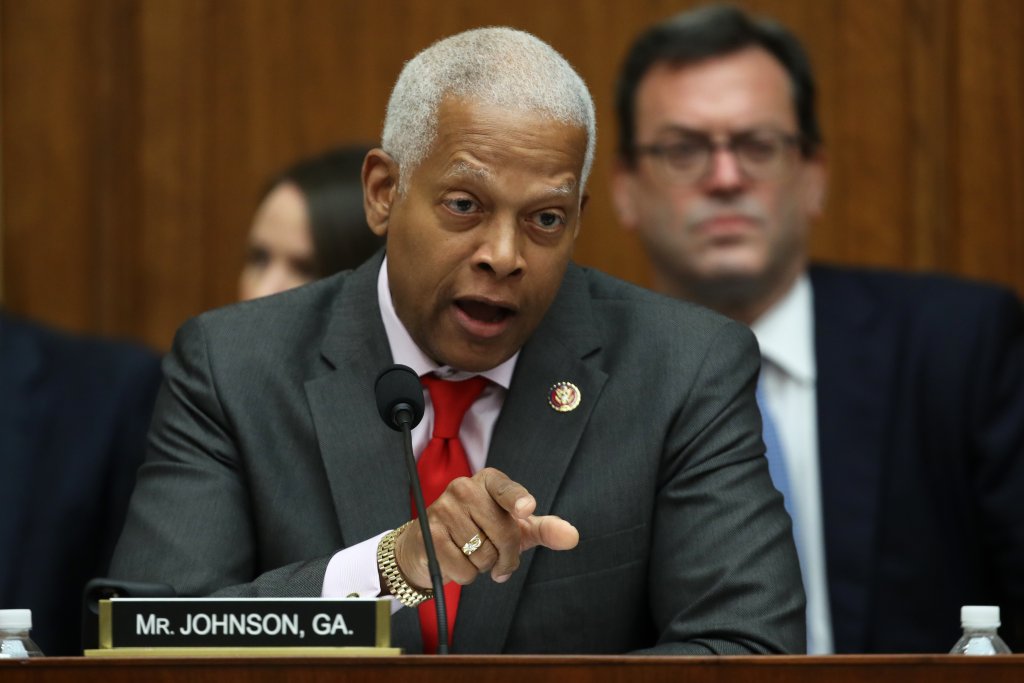

Representative Hank Johnson (D-GA), never far from controversy, has once again made headlines — this time for parroting language commonly used by hostile foreign regimes. In a recent interview with progressive radio host Dean Obeidallah, Johnson referred to the United States as “the world’s number one bully” and, more shockingly, “the Great Satan,” a term long favored by Iranian theocrats to describe America.
The remarks came during a discussion criticizing U.S. foreign policy under President Donald Trump, which Johnson characterized as imperialistic and oppressive.
“We are the world’s number one bully,” he claimed. “We are using our immense, unrivaled power to rule over those who have less power.” Then, in a moment that stunned even some of his supporters, Johnson added: “This sends a shocking message to the world that America is indeed the — what did they used to call it — the great hand of Satan, or something like that… the great Satan.”
Democrat Hank Johnson directly echoes propaganda from the terrorist Iranian regime.
JOHNSON: "We are the world's number one bully...America is indeed...the great hand of Satan...the great Satan." pic.twitter.com/3JxrccCqLY
— RNC Research (@RNCResearch) December 8, 2025
Johnson’s use of the term “Great Satan” is particularly jarring. Coined by the Ayatollah Khomeini after the 1979 Iranian Revolution, the label has been repeatedly used by the Iranian regime to justify anti-American sentiment and violence. For a sitting member of Congress to echo it — even rhetorically — is bound to raise serious concerns about judgment, loyalty, and rhetoric during a time of growing global instability.
This isn’t Johnson’s first brush with viral infamy. He became a national punchline in 2010 when, during a House Armed Services Committee hearing, he worried aloud that the U.S. military’s presence on the island of Guam might cause it to “tip over and capsize.”
His exact words: “My fear is that the whole island will become so overly populated that it will tip over and capsize.” The moment drew bewildered silence before Admiral Robert Willard, head of the U.S. Pacific Fleet at the time, calmly reassured him, “We don’t anticipate that.”
In light of that history, some might chalk Johnson’s latest comments up to his unique style of communication. But words have weight, especially when they mirror propaganda used by adversaries of the United States. At a time when global powers are watching closely, a sitting congressman likening his own country to a demonic force could easily be weaponized by those who already view American democracy with suspicion or hostility.

Johnson’s critics argue that his remarks not only undermine national credibility but also give rhetorical ammunition to regimes that threaten U.S. interests abroad. Meanwhile, supporters may see his comments as a raw — if exaggerated — critique of U.S. power. Regardless, the invocation of “Great Satan” crosses a rhetorical line that few American lawmakers have dared approach.