

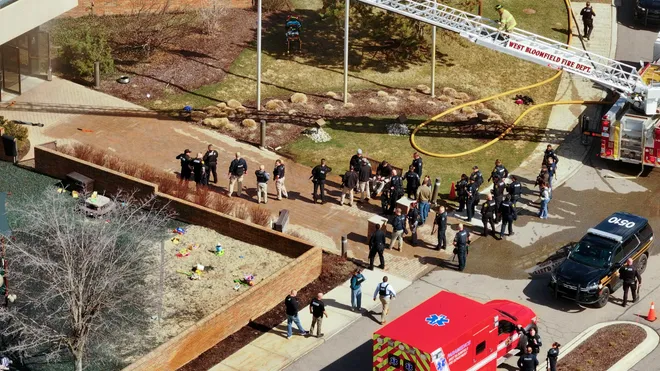

The aftermath of an attack often reveals more than the event itself. That dynamic unfolded again this week after Rep. Rashida Tlaib issued a message expressing concern and offering “thoughts and prayers” following an incident in which a Lebanese man reportedly rammed a vehicle into Temple Israel synagogue. The statement, on its face, was a routine gesture from a public official reacting to a violent act directed at a religious community. Yet the response it triggered online quickly became part of the story.
The reports coming out of West Bloomfield are horrifying. I am praying for the safety of everyone at Temple Israel. No one should face violence anywhere, especially in a place of worship.
— Congresswoman Rashida Tlaib (@RepRashida) March 12, 2026
Tlaib, a Democratic congresswoman from Michigan and one of the most outspoken critics of Israeli policy in Congress, has spent years at the center of contentious debates about Israel, Palestinian nationalism, and the boundaries of political rhetoric surrounding the conflict. Her critics frequently argue that some of her language about Israel and Zionism contributes to a climate of hostility toward Jewish institutions. Supporters, by contrast, frame her comments as part of legitimate criticism of Israeli government policy and advocacy for Palestinian rights.
Those tensions formed the backdrop for the reaction to her statement following the synagogue attack. Within minutes of her message appearing online, social media replies filled with skepticism and outright condemnation. Critics accused the congresswoman of attempting to distance herself from the consequences of rhetoric they believe has inflamed anti-Israel sentiment. Some framed the moment as political irony: a politician who has often been sharply critical of Israel now publicly condemning violence directed at a Jewish house of worship.
This you?
It is, right? Just before you got censured for chanting, "from the river to the sea" like the antisemite POS that you are.
Remember when that happened? pic.twitter.com/Q0rcfNudyd
— Chumly Pieplate (@Chumly_P) March 12, 2026
The backlash illustrates a broader pattern that has emerged in recent years. In the digital era, political figures are rarely judged only by their immediate response to a crisis. Instead, their entire history of statements and positions is pulled into the conversation almost instantly. A message intended as a straightforward condemnation can quickly become a referendum on years of political messaging.
🤔 🤔 🤔
IRGC was sharing your propaganda about the “school” that was hit…
Saw it at 3 a.m. this morning… wasn’t the terrorist involved in today’s attack from your district? pic.twitter.com/1BEC3YWCpe
— Apple Lamps (@lamps_apple) March 12, 2026
At the center of the controversy is the difficult question of where political advocacy ends and rhetorical responsibility begins. Debates about Israel and Palestine have become among the most emotionally charged in American politics, particularly since the outbreak of renewed conflict in the region. Politicians on both sides of the aisle increasingly find their words scrutinized not just for policy implications but for the tone they set among supporters.
You encourage this extremism. You applaud it.
You even like it and embrace it. Because it is the song of your people.
— Mack Swift (@swifthampton) March 12, 2026
For Tlaib, the synagogue attack placed that scrutiny under a harsh spotlight. Her statement calling for safety and expressing concern was brief and conventional, but the response demonstrated how deeply polarized perceptions of her role in the broader debate have become. To critics, the message appeared inconsistent with her previous rhetoric. To others, it was a standard response to an act of violence.