

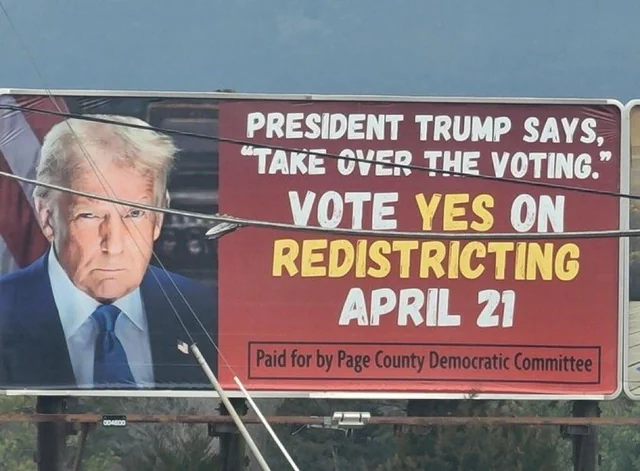

The familiar ritual unfolds almost on cue after a major political setback. When Democrats lose a high-profile fight, prominent voices often rush to cameras and microphones to warn of “election interference.” The phrase has become a staple of modern political messaging, invoked to frame losses as something more sinister than ordinary defeat. Yet in Virginia, as early voting begins on a controversial redistricting proposal, critics argue that a different kind of interference is unfolding—one rooted not in foreign actors or hacked systems, but in messaging designed to mislead voters before they ever reach the ballot box.
BREAKING - Democrats in Virginia have been caught massively interfering in elections by putting up billboards in red districts using President Trump’s image and words to claim he wants Republicans to vote yes on Democrat redistricting for Virginia. pic.twitter.com/z8MBRMMH3P
— Right Angle News Network (@Rightanglenews) March 5, 2026
Across parts of the state, billboards have appeared that opponents say create the impression that President Donald Trump supports the proposed redistricting plan. The messaging, according to critics, attempts to link Trump’s name to a measure that would reshape the state’s electoral map in ways Republicans argue would disadvantage their voters. In other versions of the billboard messaging, Trump is portrayed as wanting to “take over” voting systems—language opponents describe as intentionally provocative and detached from the context of the redistricting proposal itself.
At the same time, they are sponsoring a bill that would fine you $25,000 for this type of false advertising.
— Tim (@NASA_Tim) March 6, 2026
For Republicans and other critics of the plan, the concern is not simply partisan disagreement over how districts should be drawn. Instead, they argue the strategy represents a broader attempt to influence public perception through misleading political advertising at the very moment voters are being asked to make a decision about the state’s electoral structure. Redistricting debates are already complicated and technical; critics say injecting confusing or deceptive claims into the public discussion only deepens voter uncertainty.
Virginia put a Marxist in office. Good luck with Republicans ever winning in Virginia again. Democrats are making sure that never happens. https://t.co/BR9xaSwngO
— Mike Engleman🇺🇲 (@RealHickory) March 5, 2026
The controversy also intersects with an unusual legal backdrop. Courts have previously ruled aspects of the proposed redistricting framework illegal, yet the vote on the proposal is still proceeding. That legal gray area has created a strange political moment in which voters are being asked to weigh in on a plan whose legitimacy has already been challenged in court.
This seems like it runs afoul of one or more laws. Any legal eagles care to weigh in on this? https://t.co/KaXULlAZ5J
— Physics Geek (@physicsgeek) March 5, 2026
Complicating matters further are campaign statements made earlier in the election cycle. Virginia Democrat Abigail Spanberger previously stated she had “no plans” to pursue redistricting changes, a comment opponents now highlight as evidence of shifting political commitments. Critics argue the current push contradicts those assurances and raises broader questions about transparency in the debate.