

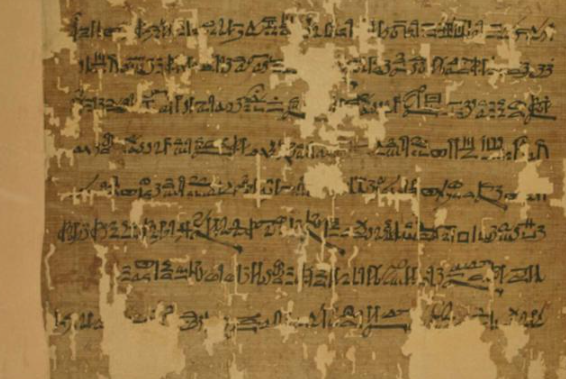

Historians and researchers are once again revisiting one of the Bible’s most mysterious claims after renewed attention has been drawn to an ancient Egyptian scroll housed in the British Museum. The document, known as Anastasi I, is more than 3,300 years old and has been in the museum’s possession since 1839. While it has long been studied as a literary and administrative text from ancient Egypt, its contents are now being reexamined by some scholars and religious researchers who believe it may lend unexpected support to the biblical account of giants.
The discussion inevitably circles back to Genesis chapter 6, one of the most enigmatic passages in the Bible. That chapter describes a world overtaken by corruption and violence, attributed in part to the Nephilim, beings said to be born from the union of “fallen angels” and human women. These figures are portrayed as giants and “men of renown,” whose influence was so destructive that God ultimately chose to cleanse the earth through a catastrophic flood. For centuries, theologians have debated whether these descriptions were symbolic, exaggerated, or literal.
The resurfacing interest in Anastasi I has added fuel to that debate. The document, believed to date to the 13th century BCE, includes references to encounters with the Shosu people, nomadic groups who appear in several ancient Egyptian texts. According to a translation often cited by researchers, the scroll describes individuals among the Shosu as measuring “four cubits or five cubits, from head to foot,” a height that would place them close to eight feet tall by modern standards. The text further describes them as fierce and unyielding, traits that reportedly instilled fear in those who encountered them.
Resurfaced 3,300-year-old Egyptian document hints at biblical giants being real https://t.co/KSlsjmg0Vj pic.twitter.com/CKCmzgXg2D
— New York Post (@nypost) February 1, 2026
For proponents of a literal reading of the Bible, the parallels are striking. Numbers 13:33 describes Israelite spies encountering giants, the sons of Anak, and feeling as small as grasshoppers in comparison. To groups such as the Pennsylvania-based Associates for Biblical Research, these overlapping accounts suggest that ancient cultures across the region may have been describing the same phenomenon from different perspectives.
Despite the renewed interest, mainstream historians remain cautious. There is still no widely accepted physical or archaeological evidence confirming the existence of a race of giants. Many scholars argue that ancient measurements, literary conventions, or symbolic language could easily account for exaggerated descriptions of height and strength. Others note that fear of enemy groups often led ancient writers to portray them as monstrous or superhuman.
At the same time, the debate is not confined to the ancient Near East. Legends of unusually large humans persist in other parts of the world, including stories from Central America and the American West. One frequently cited account involves alleged discoveries of oversized skeletons near a remote town northeast of Reno, Nevada, including reports of remains measuring seven to eight feet tall. While these claims continue to fascinate the public, scientists point out that such stories have yet to be substantiated with verifiable evidence.