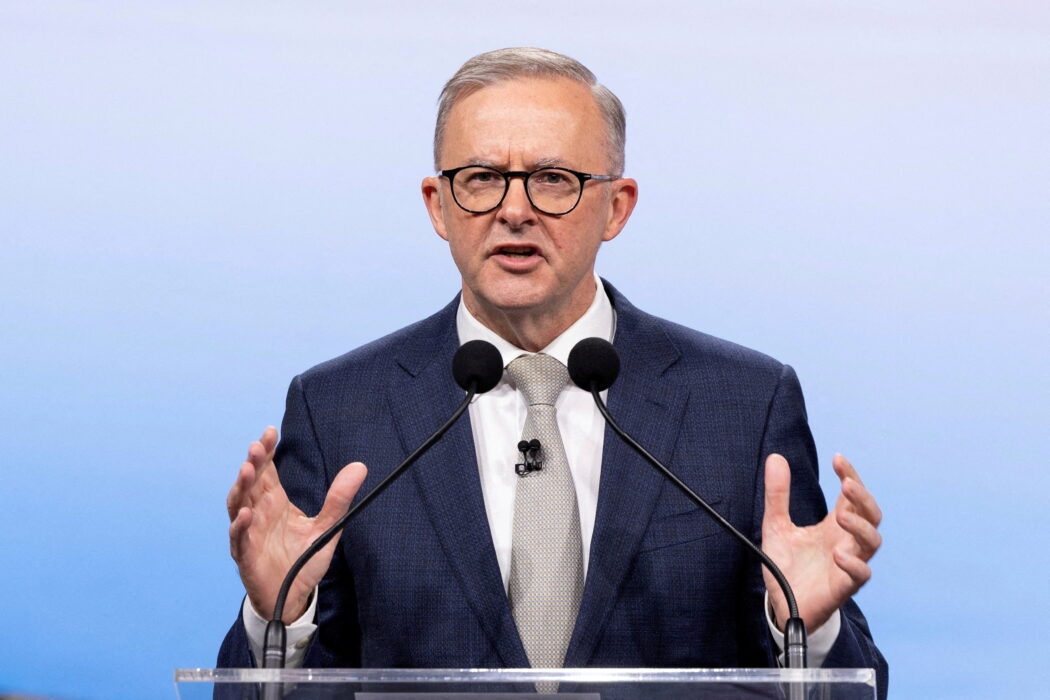

In the aftermath of Sunday’s brutal terrorist attack on a Hanukkah celebration in Australia, Prime Minister Anthony Albanese stood before the press and said what many had already concluded: the attack was “inspired by a terrorist organization, by ISIS.” A clear enough statement—until you recall that just hours earlier, he couldn’t even bring himself to mention the words “Hanukkah” or “Jews.” Only under pressure did he acknowledge the obvious, and even then, with the hesitation of a man trying to walk two contradictory lines at once.
The symbolism of the attack was unmissable: a vehicle used in the assault bearing the ISIS flag in its windshield, a direct echo of the group’s publicly stated goals. And yet, authorities continue to hedge their language, saying the motive is still under investigation. Even as Albanese acknowledged the “radical perversion of Islam,” the very phrase gives cover to a broader unwillingness to face a harder truth—that this isn’t an isolated aberration, but part of a recurring ideological pattern we’ve seen played out for decades.
The ISIS flag on the Bondi terrorist’s car. pic.twitter.com/vZpnOt87Gy
— AussieLoyalist (@LoyalistAussie) December 16, 2025
It’s been nearly 25 years since the 9/11 attacks, and almost 50 years since the Islamic Revolution in Iran. Across the globe, from Paris to Sydney, San Bernardino to Brussels, a consistent ideological threat has revealed itself, time and again, in blood and fire. But Western leaders like Albanese remain committed to the illusion that more cultural integration and softened language can somehow disarm an ideology that declares—repeatedly and in its own words—that it aims to kill Jews, Christians, and Westerners.
Those words aren’t theoretical. In January 2024, ISIS spokesman Abu Huudhayfah Al-Ansari issued a chilling directive: “Break into their homes, kill them and steal their peace of mind.” He called specifically for attacks on synagogues and churches, urging “Lions of Islam” to strike civilian targets and religious gatherings. That directive was not whispered in the shadows—it was broadcast.
And still, Albanese clings to a narrative of balance. He won’t commit to appointing a Special Envoy to Combat Antisemitism without a matching envoy to address Islamophobia. As if the firebombing of Jewish holidays requires an equal moral accounting. As if the threat is symmetrical.
🚨 WTF?! After Islamic terrorists KILLED 15 people in Australia, the prime minister warns about "right-wing extremist groups"
You've GOT to be kidding me.
If the threat was right-wingers, trust me, YOU'D KNOW. pic.twitter.com/fB7JYUewue
— Eric Daugherty (@EricLDaugh) December 15, 2025
To compound the failures, both attackers had been known to authorities since 2019. One had even been tied to a known Islamic State commander who was later prosecuted for plotting an attack. And yet they were deemed not to pose a threat. It’s a pattern we’ve seen before: red flags, ignored. Associations with jihadist networks, overlooked. The cost of that oversight was paid, once again, by innocent civilians celebrating a sacred tradition.
Despite all this, the Prime Minister and much of Australia’s political class continue to treat right-wing extremism as an equally urgent threat—while the blood from this latest ISIS-inspired attack is still being washed off the pavement.