

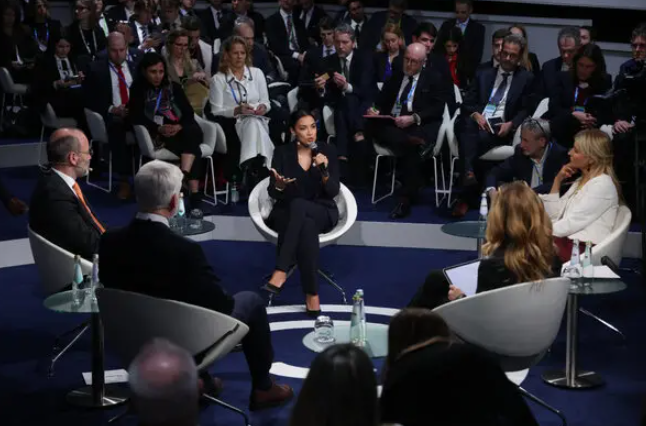

Over the weekend, the Munich Security Conference once again convened its familiar constellation of global power brokers, political dignitaries, and media luminaries. The annual gathering, long regarded as a high-profile forum for international policy debate, drew significant attention—not only for the geopolitical stakes discussed, but for the American political figures who used the platform to elevate their profiles.
Among the attendees were several prominent Democrats widely viewed as potential contenders in the 2028 presidential race. California Gov. Gavin Newsom made his customary rounds before the cameras, projecting executive poise on an international stage.
Sen. Mark Kelly spoke critically about domestic leadership while framing his concerns within the broader context of global alliances. Michigan Gov. Gretchen Whitmer delivered remarks that emphasized governance and stability, though critics suggested her tone lacked the gravitas the setting demanded.
Yet it was Rep. Alexandria Ocasio-Cortez who generated the most buzz—and controversy.
Ocasio-Cortez, a leading progressive voice since her 2018 arrival in Congress, found herself under intense scrutiny following a televised exchange regarding U.S. policy toward Taiwan. When asked to articulate the longstanding American approach, she paused, stumbled, and struggled to frame her answer clearly. The hesitation quickly circulated across social media, with critics portraying it as evidence of inexperience on foreign policy matters.
Bloomberg’s coverage of the exchange struck a notably measured tone. Reporters Nick Wadhams and María Paula Mijares Torres acknowledged that Ocasio-Cortez is better known for her domestic progressive advocacy than for foreign policy expertise, noting that she does not sit on the House Foreign Affairs or Armed Services Committees. Her legislative focus has largely centered on economic inequality, climate change, and issues affecting Latin America and Palestine.
Still, Bloomberg emphasized that her broader message in Munich centered on combating global inequality and resisting governance systems dominated by entrenched elites. In one speech segment, Ocasio-Cortez called for a foreign policy that addresses what she described as a world “dominated by a handful of elites…that sit in pretend democracies and make backdoor deals with one another.” The irony of delivering that critique within a conference hall filled with world leaders was not lost on her detractors.

Following the viral clip of her hesitation, advisers sought to contextualize the moment. Matt Duss, who advises Ocasio-Cortez on foreign policy, suggested that her pause reflected caution rather than confusion. “I wish more politicians would wait to answer instead of rattling off talking points,” he said, framing the exchange as thoughtful deliberation rather than unpreparedness.
Ultimately, Ocasio-Cortez pivoted to a broader appeal for renewed multilateral cooperation, urging leaders not to retreat into isolation but to “deepen our partnership” and reaffirm shared democratic values. The remarks reportedly drew sustained applause from attendees, signaling that her message resonated with portions of the international audience.