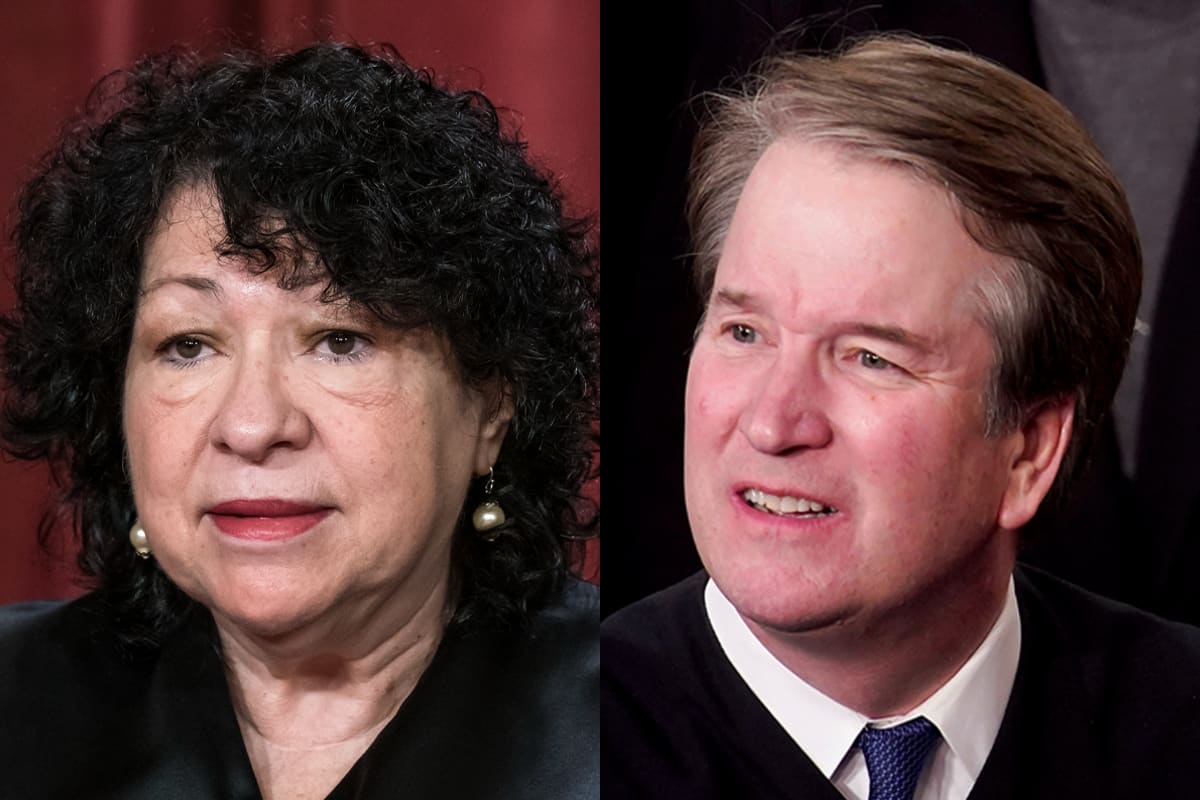

Justice Sonia Sotomayor’s remarks at the University of Kansas School of Law didn’t just raise eyebrows—they crossed a line that Supreme Court justices rarely approach in public. Speaking about an immigration-related case, Sotomayor took aim at a concurring opinion authored by Justice Brett Kavanaugh. Though she avoided naming him directly, the reference was unmistakable, and the criticism went beyond legal disagreement into personal territory.
Her comment suggested that the author of the opinion came from a background too insulated to understand the real-world consequences of immigration enforcement. She described him as “a man whose parents were professionals” who likely “doesn’t really know any person who works by the hour.” It was a pointed remark, and one that shifted the focus away from jurisprudence and toward personal biography.
Justice Sonia Sotomayor used an appearance this week to suggest that Justice Brett Kavanaugh is an out-of-touch elitist. The comments were a disturbing departure from the tradition of collegiality and civility on the court. It was unfair and unwarranted...https://t.co/72aJImnbs7
— Jonathan Turley (@JonathanTurley) April 10, 2026
That kind of framing is unusual for the Court, where disagreements are typically confined to written opinions and legal reasoning. Public appearances by justices tend to avoid direct criticism of colleagues, especially in ways that question personal experience rather than legal interpretation. Sotomayor’s comments stood out precisely because they broke from that norm.
She continued by emphasizing the role of personal experience in shaping judicial perspective, framing her own background as a source of broader understanding.
The implication was clear: that lived experience can influence how justices interpret the impact of laws, particularly on people without political or institutional power. While that argument has been part of broader legal debates for years, delivering it in this context—and in this manner—gave it a sharper edge.
Justice Sonia Sotomayor has issued a highly unusual public apology to a colleague, saying her criticism of Justice Brett Kavanaugh was unfair. https://t.co/TUwJcAD8eA pic.twitter.com/eUajHvTc7m
— CNN Politics (@CNNPolitics) April 15, 2026
The response came quickly. Legal analysts, including George Washington University law professor Jonathan Turley, criticized the remarks as unfair and inappropriate, arguing that they reduced a colleague’s judicial reasoning to assumptions about upbringing. Others focused less on the substance and more on the breach of decorum, noting that the Court’s institutional credibility relies in part on the perception of mutual respect among its members.
Within days, Sotomayor issued a public apology. In a statement released by the Court, she acknowledged that her remarks were inappropriate and confirmed that she had apologized directly to her colleague. The statement was brief and direct, offering no elaboration beyond expressing regret.