

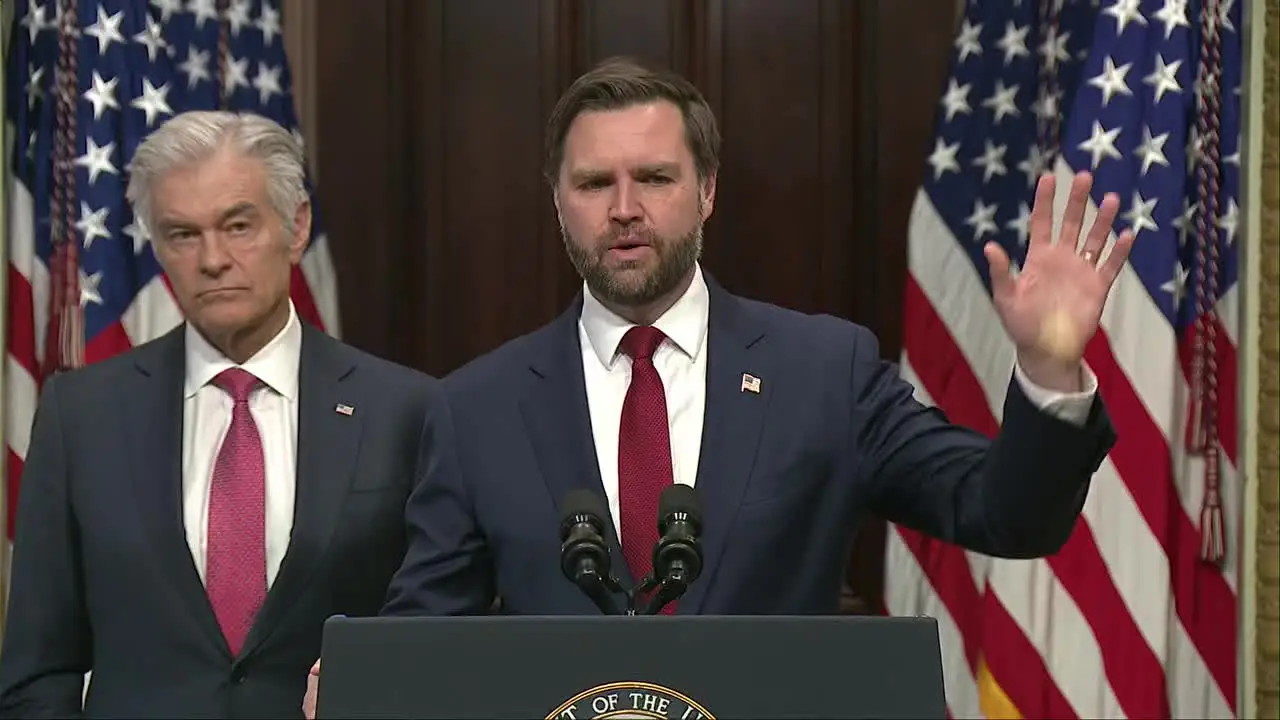

In a forceful declaration during Tuesday night’s State of the Union address, President Donald Trump unveiled what he described as a sweeping “whole of government” crackdown on fraud — with Vice President JD Vance tapped to lead the charge. By Wednesday, that promise had already translated into action, with Minnesota becoming the first major test case.
Standing alongside Centers for Medicare & Medicaid Services Administrator Dr. Mehmet Oz, Vice President Vance announced that federal Medicaid payments to the state of Minnesota would be paused. The move, he explained, is designed to pressure state leadership into aggressively addressing what the administration characterizes as systemic fraud within its Medicaid program.
🚨 @VP: "We have decided to temporarily halt certain amounts of Medicaid funding that are going to the state of Minnesota in order to ensure that the state of Minnesota takes its obligation seriously to be good stewards of the American people's tax money." pic.twitter.com/XD0JMA5p3w
— Rapid Response 47 (@RapidResponse47) February 25, 2026
Vance made clear that healthcare providers in Minnesota would not immediately feel the financial squeeze. According to the vice president, the state has already disbursed payments to providers. The freeze applies to federal reimbursements heading to the state government itself. “The providers on the ground in Minnesota have already been paid,” Vance stated. “What we are doing is we are stopping the federal payments that will go to the state government, until the state government takes its obligations seriously to stop the fraud that's being perpetrated against the American taxpayer.”
The announcement framed Minnesota — led by Democratic Gov. Tim Walz — as emblematic of what the administration views as lax oversight in certain blue states. Vance’s remarks were pointed and direct. He declared that the era of taxpayers being exploited through public benefit programs “is stopping today,” emphasizing that the administration is mobilizing federal agencies in a coordinated campaign to root out abuse.
.@VP: "Far too many people have gotten rich by taking what is best of the American spirit and getting rich off of it instead of providing services to kids who need it. That is stopping today." https://t.co/AjAoc9osmh pic.twitter.com/LXJQzhrN0Z
— Rapid Response 47 (@RapidResponse47) February 25, 2026
Dr. Oz amplified the urgency of the effort, describing it as “the largest anti-fraud effort” ever undertaken by CMS. He detailed examples of alleged misconduct, including fraudulent claims tied to services for autistic children. While he did not provide exhaustive figures during the press conference, the implication was clear: the administration believes significant sums are being improperly claimed.
Oz also confirmed that Governor Walz has been formally notified. In a letter to state leadership, CMS outlined that federal funds will be released only after Minnesota proposes and implements a “comprehensive corrective action plan” within 60 days. Failure to comply could result in as much as $1 billion in deferred payments in 2026.
.@DrOzCMS details just a fraction of the fraud in Minnesota: One scheme involved criminals paying moms $1,000 to enroll their children — falsely — as autistic, then billed Medicaid millions of dollars for services that were never rendered. https://t.co/AjAoc9osmh pic.twitter.com/7AKMGSKwPj
— Rapid Response 47 (@RapidResponse47) February 25, 2026
“This is a problem with the leadership of Minnesota, and other states that do not take Medicaid preservation seriously,” Oz said, stressing that unchecked fraud ultimately threatens the sustainability of the program itself. The concern, he noted, is not merely financial but moral — that resources intended for vulnerable Americans could be depleted if abuse is not addressed.

.@DrOzCMS: "If Minnesota fails to clean up the systems, the state will rack up $1 billion of deferred payments this year. @GovTimWalz has 60 days to respond... We have more announcements of other states coming soon." https://t.co/AjAoc9osmh pic.twitter.com/nw18bsv64z
— Rapid Response 47 (@RapidResponse47) February 25, 2026
The administration’s message is unmistakable: federal dollars will now come with heightened scrutiny, and states unwilling to tighten oversight may face financial consequences.