

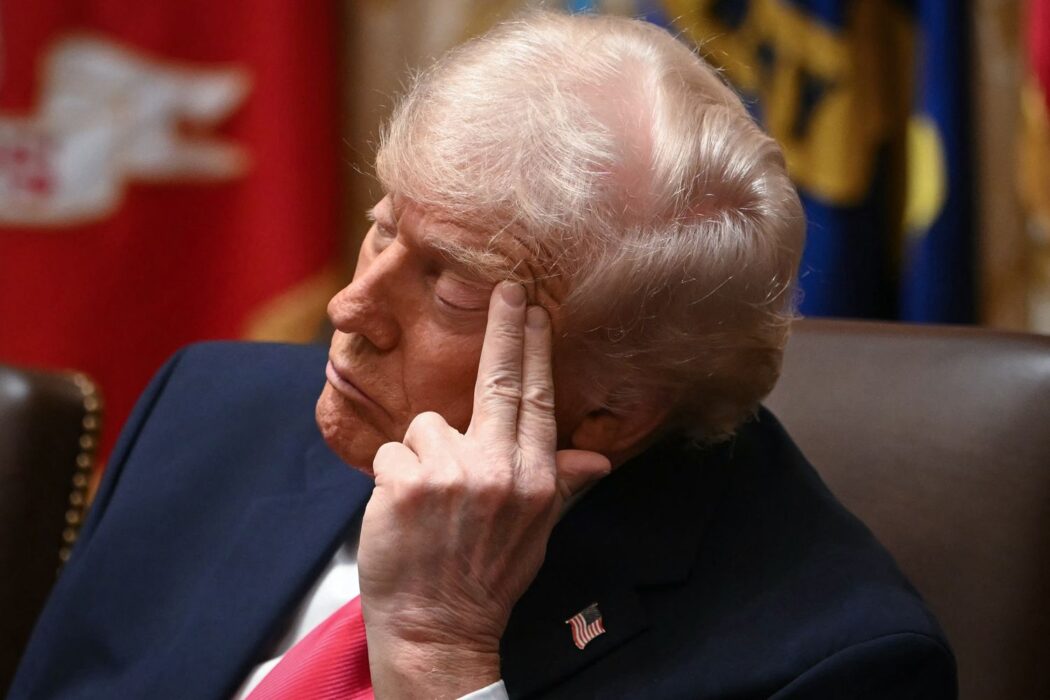

In politics, few rules are more unforgiving than the standards you set for others eventually being applied to yourself. President Donald Trump, in his second term and at 79 years old, now finds himself face-to-face with the very expectations he once weaponized—most notably in his relentless portrayal of Joe Biden as “Sleepy Joe.” But what happens when the man who once mocked presidential drowsiness becomes the subject of those very optics?
Tuesday’s Cabinet meeting, which clocked in at nearly three hours, was vintage Trump in setup: a gathering of loyal secretaries praising his policies, a stage for direct engagement, and a moment to contrast himself with his predecessor. Trump kicked things off with fire, dismissing The New York Times as “not sharp” and declaring himself “sharper than I was 25 years ago.”
But what followed undercut the declaration. Cameras appeared to capture him nodding off multiple times, his eyelids heavy and unmoved for up to 15 seconds at a time, while Cabinet members offered glowing remarks just feet away.
This isn’t the first time such images have emerged—similar footage from November showed Trump struggling to stay awake during a White House event. These episodes raise a fair question: do they represent a serious health concern? Not necessarily. Anyone maintaining Trump’s notoriously packed schedule—late-night posts on Truth Social, early-morning briefings, relentless public engagements—could plausibly find themselves caught in a drowsy moment, especially during a long meeting filled with ceremonial flattery.
But what makes this moment politically sticky is the context. Trump built part of his brand on mocking Biden’s age, energy, and cognition. His criticisms weren’t limited to policy—they targeted visuals. He made Biden’s supposed naps, beach rests, and dazed expressions a cornerstone of ridicule. “You’ll never see me sleeping in front of the camera,” Trump once said. Until now.
The media, predictably, is capitalizing on the contrast. The New York Times, The Washington Post, and other outlets have picked up the scent of cognitive scrutiny, turning their analytical lens toward Trump after years of focusing almost exclusively on Biden. And while Trump’s defenders rightly point out his more robust public presence compared to Biden—more press availability, more visible activity, and certainly more unscripted remarks—the optics of dozing off, especially when you've made drowsiness a political sin, are difficult to explain away.
The White House response, delivered by Press Secretary Karoline Leavitt, was firm and enthusiastic. She maintained that Trump had been “listening attentively” and running the meeting with full control, even delivering a fiery Q&A session that capped off the three-hour event. She also pointed to the president’s full Cabinet meeting schedule this year and his ongoing engagement with major policy issues. Her message: Trump may blink a little slower these days, but he’s still running the show.

That may well be true. But a broader truth remains: political perception is shaped as much by image as by fact. Trump’s long-standing refusal to disclose full medical records, coupled with his exaggerated past health claims (including the notorious 2015 letter declaring him the “healthiest individual ever elected”), leaves little room for nuance when visible signs of fatigue appear.
As with so many other things in American politics, the answer may depend not on the act itself, but on who the cameras are focused on