

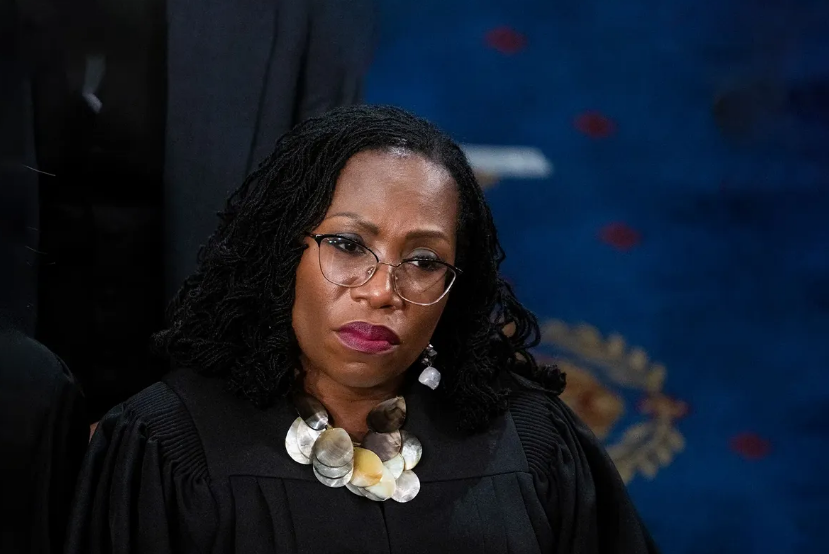

Supreme Court Justice Ketanji Brown Jackson is facing renewed scrutiny after her latest dissent sharply diverged not only from the Court’s conservative majority, but also from her liberal colleagues. The case in question — which upheld the Trump administration’s authority to begin planning large-scale reductions in the federal workforce — ended in an 8-1 decision, with Jackson standing alone in dissent.
Her opinion, described as “hubristic and senseless,” was sharply criticized by legal scholar Hans von Spakovsky, a senior fellow at The Heritage Foundation. According to von Spakovsky, Jackson’s dissent reflects not only a lack of legal rigor but also a fundamental misunderstanding of the judiciary’s role.
“Only the lone dissenter, Brown Jackson, was once again engaging in an emotional tirade about the idea that — horror, shock — federal employees might actually lose their jobs,” he told The Daily Wire.
In contrast, Justice Sonia Sotomayor — often aligned with Jackson ideologically — sided with the majority, making it clear she recognized the Executive Order as compliant with existing law. “Here, however, the relevant Executive Order directs agencies to plan reorganizations and reductions in force ‘consistent with applicable law,’” Sotomayor wrote, distancing herself from Jackson’s sweeping objections.
The growing divide is not isolated. In a separate case last month concerning birthright citizenship, Justice Amy Coney Barrett indirectly called out Jackson’s reasoning as disconnected from any coherent legal doctrine.
Barrett remarked that Jackson’s dissent was “tethered neither to [legal] sources nor, frankly, to any doctrine whatsoever,” and implied her argument leaned more on emotional rhetoric than constitutional analysis.
Von Spakovsky added that while he disagrees with liberal justices like Kagan and Sotomayor, they at least attempt to ground their positions in law. Jackson, he contends, repeatedly veers into policy arguments — such as asserting there’s “no need” to eliminate federal jobs — which are outside the judiciary’s constitutional purview.

The case at hand reaffirmed the president’s authority to direct executive agencies to plan reorganizations in line with federal law, a position supported across the Court’s ideological spectrum — with the sole exception of Jackson. The Court's decision comes amid President Trump’s ongoing push to reduce bureaucratic sprawl and restructure federal agencies to better reflect his policy agenda.
Critics now point to Jackson’s repeated departure from standard judicial reasoning as a troubling sign of her fitness for the bench. “Frankly, she was a big mistake getting put on the court,” von Spakovsky concluded. “Sotomayor, Kagan — they do [have legal acumen], even though I think they’re often wrong. But I don’t think [Jackson] does.”